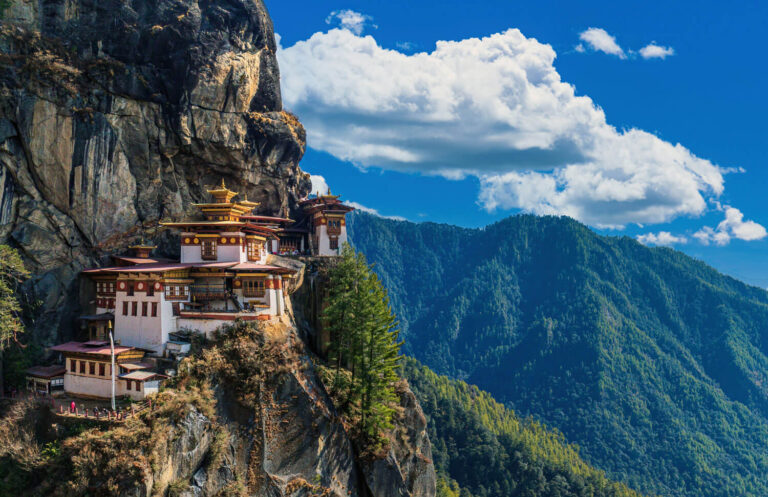
It is not a walk. It is a climb. This article is the description we give clients before they book, so that the day is planned properly rather than survived.
The numbers
- Ascent: roughly 1,700 feet (520 m) from the car park to the monastery.
- Finishing altitude: about 10,200 feet (3,120 m).
- Time up: two to three hours, depending on pace and how many stops you take.
- Time down: about one and a half hours.
- Surface: a rough, dusty, switchbacking path through pine forest, with tree roots and loose stone. Dusty in autumn, slippery for a day or two after rain.
- The sting: stone stairs at the end, which descend into a gorge and then climb back up to the monastery buildings.
Those stairs are the part people find hardest, and almost nobody expects them. You have already climbed for two hours, you can see the monastery across the gorge, and then the path goes down about 300 steps and back up the other side. Coming home, you do it again in reverse.
What it actually feels like
The first section, from the car park to the cafeteria at the halfway point, is a steady uphill grind through forest on a wide track. Ponies use it, which means it is churned and dusty. There is little view for the first forty minutes and then it opens.
The cafeteria sits at roughly the halfway mark and has the first proper view of the monastery across the valley. This is a legitimate destination in its own right. We say that clearly to every client, because the people who suffer on this climb are usually the ones who decided in advance that stopping there would be a failure.
Above the cafeteria the path narrows, the trees thin and the gradient stays honest. There is a viewpoint above with prayer flags where most people stop for the photograph everyone recognises. Then the stairs.
At the monastery you leave bags, cameras and phones in lockers, take your shoes off, and go inside. Photography is not permitted in the temples. This surprises people who have climbed for three hours with a camera and it is not negotiable.
Who finds it hard
In our experience, the difficulty divides along three lines and fitness is only one of them.
Altitude. You finish at about 10,200 feet (3,120 m), having started the day at about 7,300 feet (2,225 m) in Paro. That is not dangerous altitude, and it is enough to make a moderate climb feel harder than the same climb at sea level. People who arrive fit from a low-altitude country and treat it as an ordinary hill are the ones who struggle.
Timing in the itinerary. Doing this on day two of a Bhutan trip is a substantially worse experience than doing it on day seven. We schedule it late, always, and if your proposal from anyone else has it early, ask why.
Knees. The descent is the part that hurts the day after. Poles help more on the way down than on the way up, and we would take them.
Age is a poor predictor. We have had people in their seventies reach the monastery comfortably and people in their thirties turn back at the cafeteria. What predicts success is going slowly from the first step, starting early, and drinking more water than feels necessary.
How to do it well
Start at seven. The light is better, the path is cooler, the pony traffic is lighter and you are back for a long lunch. Bhutan is not a country of early starts generally, and this is the exception.
Go slower than feels right. The people who arrive at the top comfortably are almost always the ones who looked slow at the bottom.
Take proper walking shoes. Not trainers with worn soles. The path is dust over stone and it is slippery in both directions.
Layer. It is cold at the car park at seven, warm on the climb, and cold again at the monastery in the wind.
Ponies go halfway and no further. A pony can carry you up to the cafeteria. It cannot take you beyond it, and it cannot take you down at all, because the descent is too steep for a rider. If you use one, be clear that you are buying the first half only.
Treat the cafeteria as a fine outcome. The view from there is the view in most of the photographs. Nobody who stops there has failed at anything.
When to climb it
The best months are October and November, when the path is dry and the air is clear, and March to May, when it is warmer and dustier. After monsoon rain the stone is genuinely slick, and in the monsoon itself the whole thing is cloud, mud and leeches lower down. Bhutan month by month covers the rest of the calendar.
In deep winter the climb is fine, cold, and often the clearest air of the year. Ice on the upper stairs is possible after snow and your guide will make the call.
If you want more than a day walk: the Druk Path
Tiger’s Nest is the walking most Bhutan visitors do. If you want a proper trek, Bhutan has one accessible route and it is worth understanding how different it is.
The Druk Path runs five walking days along a high ridge between Paro and Thimphu, past a string of glacial lakes, over a high point at about 13,800 feet (4,200 m), with no villages and no roads in between. Camps sit at about 11,600 feet (3,540 m), 11,800 feet (3,600 m), 12,300 feet (3,750 m) and 13,000 feet (3,960 m).
Three things make it harder than the mileage suggests:
- It is a camping trek, not a lodge trek. There are no teahouses in Bhutan. You walk with a licensed guide, a cook, a camp crew and pack animals, sleeping in a two-person tent with a foam mat, washing from a bowl of hot water, and using a toilet tent. That is more comfortable than it sounds and it is not a hot shower for five days.
- The altitude is the difficulty, not the distance. Four consecutive nights above 11,500 feet (3,500 m). Most people get headaches and sleep badly, which is normal. Worsening headache that painkillers do not touch, vomiting, confusion or breathlessness at rest are not normal and mean descending immediately. Our guides descend rather than argue.
- Day one is the hardest single day. Roughly 3,400 feet (1,040 m) of ascent from Paro to the camp below Jele Dzong, on legs that have not walked yet.
Nights at the high camps drop well below freezing, often in October. A sleeping bag rated to about 5 Fahrenheit (minus 15 C) is the right choice rather than a summer bag.
We build it as a twelve day trip, with four valley days either side. Those days exist for acclimatisation and they are not padding: Tiger’s Nest sits inside them as a training day, which is exactly the right use for it.
Beyond the Druk Path, the Jomolhari routes go higher and longer, and the Snowman trek across the high north is one of the most demanding commercial treks anywhere, with a real failure rate. We will talk you out of that one unless you have the experience for it. Our comparison of trekking across Asia sets Bhutan against Nepal, Georgia, Kyrgyzstan and Japan.
One thing that applies to every Bhutanese trek and catches people out: the Sustainable Development Fee is charged for every night you are in the country, including the nights you spend in a tent on a mountain.
Plan this trip
Tell us your dates and the places you want to see, and we build your trip as a $39 day-by-day plan, with recommended hotels by level and every transfer set out step by step.
Keep reading
- Bhutan: the complete guide to planning your trip
- The Druk Path trek in 12 days
- Bhutan for the first time
- Bhutan month by month
- Trekking in Asia compared
- All our Bhutan trips