The big ones
Badaling, and the Great Wall done as a half day
The wall is the best day in northern China and it is routinely ruined by the two decisions that go with it. Badaling is the closest section to Beijing, the most heavily restored and by a wide margin the most crowded, and on a bad day it is a queue on a wall. And the half-day version, usually bolted onto the Ming Tombs, gives you ninety minutes of wall after two hours in a coach.
Give the wall a full day, leave the city by seven thirty, and go to Mutianyu if you want restored wall with a cable car or Jinshanling if you can walk two to three hours on unrestored ridge with nobody on it.
A fifth city
The most common thing we remove from a draft itinerary somebody has sent us. Beijing, Xi’an, Guilin, Shanghai and then Hangzhou, in fourteen days, means four moves plus a fifth, and each move costs the middle of a day. Take the fifth city out and give those three days to Chengdu or to the karst country, where you were going to be anyway.
The rule we build to is one hotel change every two and a half days. The arithmetic is in how many days do you need in China.
The Ming Tombs
A long approach, a modest reward, and it is almost always sold as the filler on a Great Wall day, where it does real damage by cutting the wall time in half. If the Ming dynasty is a genuine interest, give it its own morning. Otherwise it is the easiest thing in this article to remove.
Tibet as a three-day add-on
Tibet is a serious destination and a separate planning exercise. It needs permits arranged through a licensed operator, independent travel is not possible, the altitude at Lhasa deserves respect, and the region can close to foreign visitors at short notice. Three days tacked onto a China circuit gives you an airport, a headache and a monastery. Three weeks, or a dedicated trip, gives you Tibet.
Xinjiang on a first visit
The Silk Road route through Turpan, Urumqi and Kashgar is one of the best fourteen day trips in Asia and we build it gladly. It is not a first China trip. Checkpoints are part of travel in the region, journeys take longer than the map suggests, and permitted routes and access can change at short notice, so we confirm the current position before we build anything and tell you plainly if it has moved. Go on a second visit, with time, and give it the full two weeks.
The tourist-facing things
Wangfujing snack street
Scorpions on sticks, photographed by domestic tourists and eaten by nobody. It is not Beijing food. Ten minutes away there are lanes where people are actually having dinner.
Nanluoguxiang
The famous hutong lane is now a shopping queue. Wudaoying and Fangjia are the same idea with residents on them, and the lanes around the Drum Tower are better again.
The four-hour Li River cruise
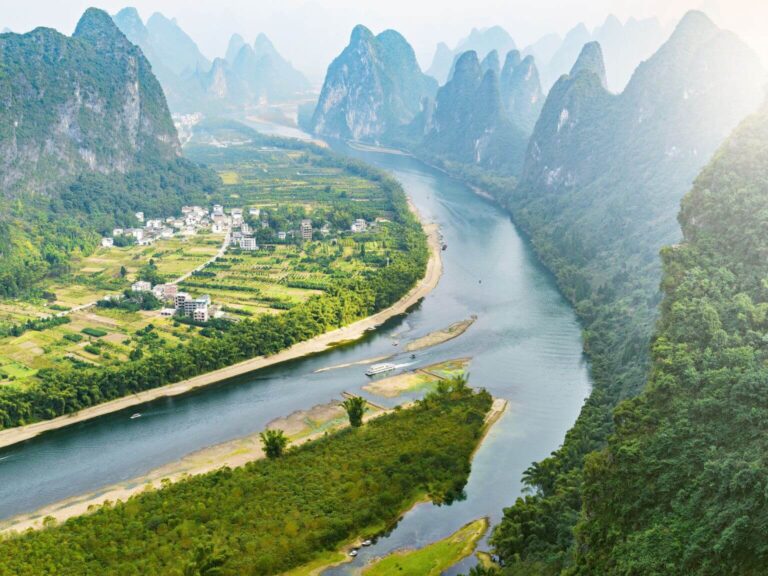
The Guilin to Yangshuo boat is the standard product and it is three hundred people on a deck at midday. The same landscape is available on a private bamboo raft on the Yulong tributary at first light, with mist on the water, for ninety minutes, and on the Xingping reach of the Li in the afternoon by small boat. Both are better and one of them is cheaper.
The shopping stops
Jade factories, silk workshops, pearl showrooms and tea ceremonies presented as culture and priced as retail. If a guide takes you to one, the itinerary was not written for you. Ours do not, and if you actually want to buy tea we will take you to the Longjing hills where it is grown.
The Yu Garden bazaar in the middle of the day
Shanghai’s old town bazaar at two in the afternoon is a crush around a souvenir stall. At eight in the morning the garden itself is quiet and genuinely lovely, which is a difference of six hours rather than of taste.
The full-length opera and the dynasty dinner show
Beijing opera is an acquired taste and the two-hour version in a hotel ballroom acquires it for nobody. Xi’an’s Tang dynasty dinner show is a buffet with costumes. If you are curious about the opera, our partner team books a short programme at a small theatre, which is a completely different evening.
The Olympic Green
Impressive in 2008 from a passing taxi. A large expanse of concrete now.
The ones that need conditions attached
The Terracotta Army
Not a skip. It earns its reputation completely, and it is the most crowded place on any classic itinerary by a wide margin. The conditions: go early, go with a guide who can explain the numbering of the pits and what the bronze chariots actually are, and give it two and a half to three hours rather than a whole day.
The Yangtze and the Three Gorges
Three nights on a river ship is a genuine experience and it is slow, which is the point. It belongs on a three week trip, as in deep China in 21 days, and it does not belong on a fourteen day one, where those three nights would buy you Chengdu and the wall done properly.
The Longji rice terraces
Spectacular, and a long day with a great many steps. If you have a full day and legs that like stairs, go. If you have half a day, or knees with opinions, take the flat cycling afternoon between the karst hills instead. We ask which one you are rather than assuming.
West Lake in Hangzhou
Beautiful and extremely popular. Go at seven in the morning or in the evening, or spend the day up in the Longjing tea villages instead and see the lake at dusk.
Zhangjiajie
The sandstone pillars are remarkable, the site is a long detour from any classic route, and it is one of the busiest domestic destinations in China. On a first two week trip, it costs you three days including travel. On a longer trip, or for a photographer, it is a fair trade.
The practical skips
Skip the hotel breakfast. In a country with the best street breakfast in Asia, the buffet in the basement is the least interesting meal of your day.
Skip self-drive. It is possible with paperwork and we almost never recommend it. Cities are congested and a car with a local driver in the countryside costs less than you think.
Skip the cheapest room on a booking site in a small town. Hotels must be licensed to take foreign guests and not all of them are, and the desk is a bad place to discover it.
Skip buying rail tickets at the station on the day. Tickets are sold against your passport, popular legs sell out, and the queue is not where you want to be at eight in the morning.
Skip the first week of May and the first week of October. The two national holiday weeks are the busiest travel periods in the world. If your dates are fixed to them we route you away from the headline sites, and we would rather move your dates. The calendar is in China month by month.
Skip planning to use cash. China runs on QR payment. Get Alipay or WeChat Pay working with an international card before you fly, which we set up and test with you along with a VPN, so your phone behaves in China the way it does at home.
What we would add instead
- A quiet section of the Great Wall, with a village lunch below it, in place of Badaling and the tombs.
- A third night in Chengdu, which is the city our travellers most often say they wish they had given more time.
- Guizhou, for the Miao and Dong villages, the drum towers and the wind and rain bridges, which almost no foreign itinerary includes.
- Shaxi, a two hour drive from Dali, the best-preserved market town in Yunnan, and the place people say they would have given another two days to. See Yunnan on foot.
- Pingyao, a walled Qing dynasty merchant town where you sleep inside the walls in a courtyard inn, on the rail line between Beijing and Xi’an.
- Dunhuang, for the Mogao caves, which hold a thousand years of Buddhist painting in nearly five hundred grottoes and which are timed, capped and worth booking well ahead.
The honest summary
The classic circuit of Beijing, Xi’an and Shanghai is a good trip and we build it constantly. The Great Wall, the Terracotta Army and the Bund are famous for reasons that survive contact. But if you have travelled in Asia before, or you have more than twelve days, we would rather send you to Yunnan, to Sichuan and its western rim, or to Guizhou and Guangxi, and we will say so in the first email rather than after you have booked.
Plan this trip
Tell us your dates and the places you want to see, and we build your trip as a $39 day-by-day plan, with recommended hotels by level and every transfer set out step by step.
Keep reading
- China: the complete guide to planning your trip
- How many days do you need in China?
- Beijing in four days
- Yunnan on foot
- Classic China in 12 days
- All our China trips