The city sits at about 2,600 feet (790 m) on a slope, with the Trans-Ili Alatau directly above it and peaks over 13,000 feet (4,000 m) visible from ordinary residential streets. It is green, heavily planted, laid out on a grid that runs uphill, and it has a coffee and restaurant culture that visitors do not expect at all. It was the capital until 1997 and it is still the country’s centre of gravity.
The plan below alternates: a city day, a mountain day, a slow day. That alternation is deliberate, because Almaty at 2,600 feet and Shymbulak at 10,500 feet (3,200 m) are two different holidays and doing them on consecutive mornings is what makes three days feel like more.
Day one: the city on foot
Morning: the Green Bazaar
Go first and go early, because the Zelyony Bazaar is the clearest single explanation of Kazakhstan that exists and everything you see later makes more sense afterwards.
Downstairs: horse meat butchers with kazy, the cured horse sausage, hanging in loops. Dried apricots, raisins and walnuts from the south, sold by women who will make you taste four kinds before you buy. Mountains of kurt, the hard salted dried cheese balls that are the road snack of the steppe. Honey from the foothills. And a full row of Korean pickle counters, which is the first sign of a story most visitors have never heard: the Korean population deported here from the Russian Far East in 1937, whose cooking is now simply Kazakh food.
Eat here. A bowl of laghman, hand-pulled noodles with lamb and peppers, costs four to seven dollars, and a samsa straight off the wall of a tandyr oven costs one or two. The full ordering guide is in what to eat in Kazakhstan.
Late morning: Panfilov Park and Zenkov cathedral
Ten minutes’ walk. The park is a block of old trees with a wooden cathedral in the middle of it, built in 1907 by the architect Zenkov almost entirely of Tian Shan spruce and, famously, without nails in the structure. It survived the 1911 earthquake that flattened most of the city, which is the point of the building rather than a footnote to it. Bright yellow, pink and blue, and unlike anything else in Central Asia.
At the far end of the park is the war memorial, enormous and unsubtle and still visited by wedding parties on Saturdays.
Afternoon: the Golden Man, then the baths
The Central State Museum holds the Golden Man of Issyk, a Saka warrior’s burial suit reconstructed from some four thousand gold plates, found in a kurgan an hour outside the city. It is the national symbol and it is genuinely remarkable. The rest of the museum is uneven and an hour and a half is enough.
Then the Arasan baths, a large Soviet-era bathhouse complex with Russian, Finnish and Turkish sections, still entirely local. An hour and a half here in the late afternoon is the correct end to a walking day and it costs very little. Take flip-flops.
Evening
Book something. Almaty has a serious modern restaurant scene working with steppe meat, wild herbs from the mountains above the city and fish from the Caspian and the Ili, at a fraction of Western prices. Dinner in a good restaurant is twenty to forty dollars a head and the top of the market runs sixty to a hundred and ten.
The one instruction we give every client: do not eat in your hotel in Almaty.
Day two: up the mountain
The whole day is above the city and it climbs steadily, which is also the sensible way to feel out the altitude.
Morning: Medeu and Shymbulak
Twenty-five minutes by road from the centre, Medeu is an outdoor speed skating rink at 5,550 feet (1,690 m), built into a gorge below a huge concrete mudflow dam. Dozens of world records were set on its ice because of the altitude and the mountain water. In winter you can skate on it. In summer you can walk the 842 steps up the dam, which is a straightforward and unglamorous thirty minutes with a good view at the top.
Above Medeu, the Shymbulak gondola runs in three stages to about 10,500 feet (3,200 m). Shymbulak is a real ski resort in winter, with proper terrain, and in summer it is a lift-served viewpoint over the Trans-Ili Alatau. Take the full lift. The top stage is the one that shows you the range.
Allow four hours for both, and take a layer: the top is twenty to twenty-five degrees Fahrenheit (twelve to fourteen degrees Celsius) colder than the city.
Afternoon: Big Almaty Lake
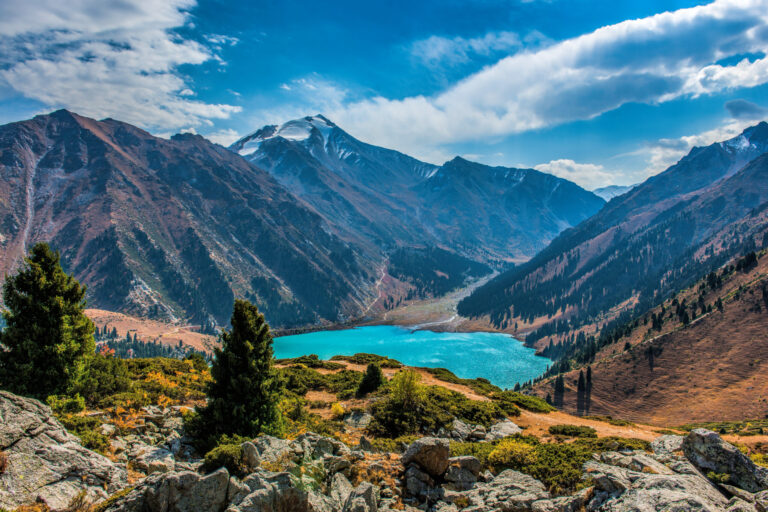
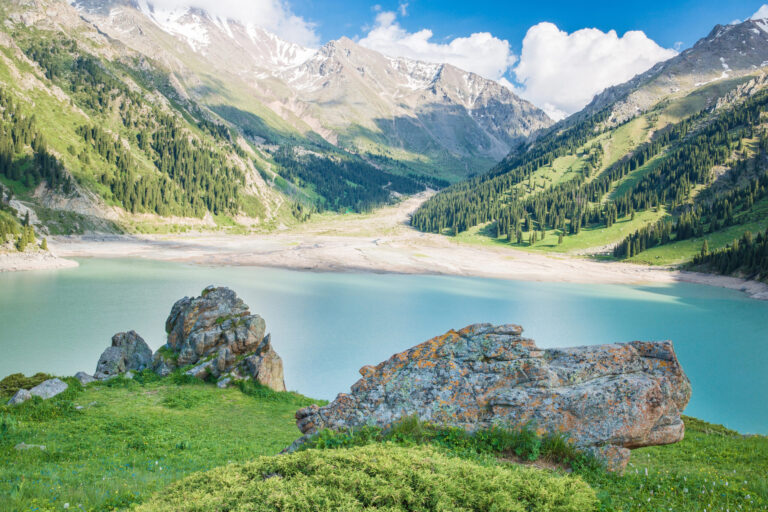
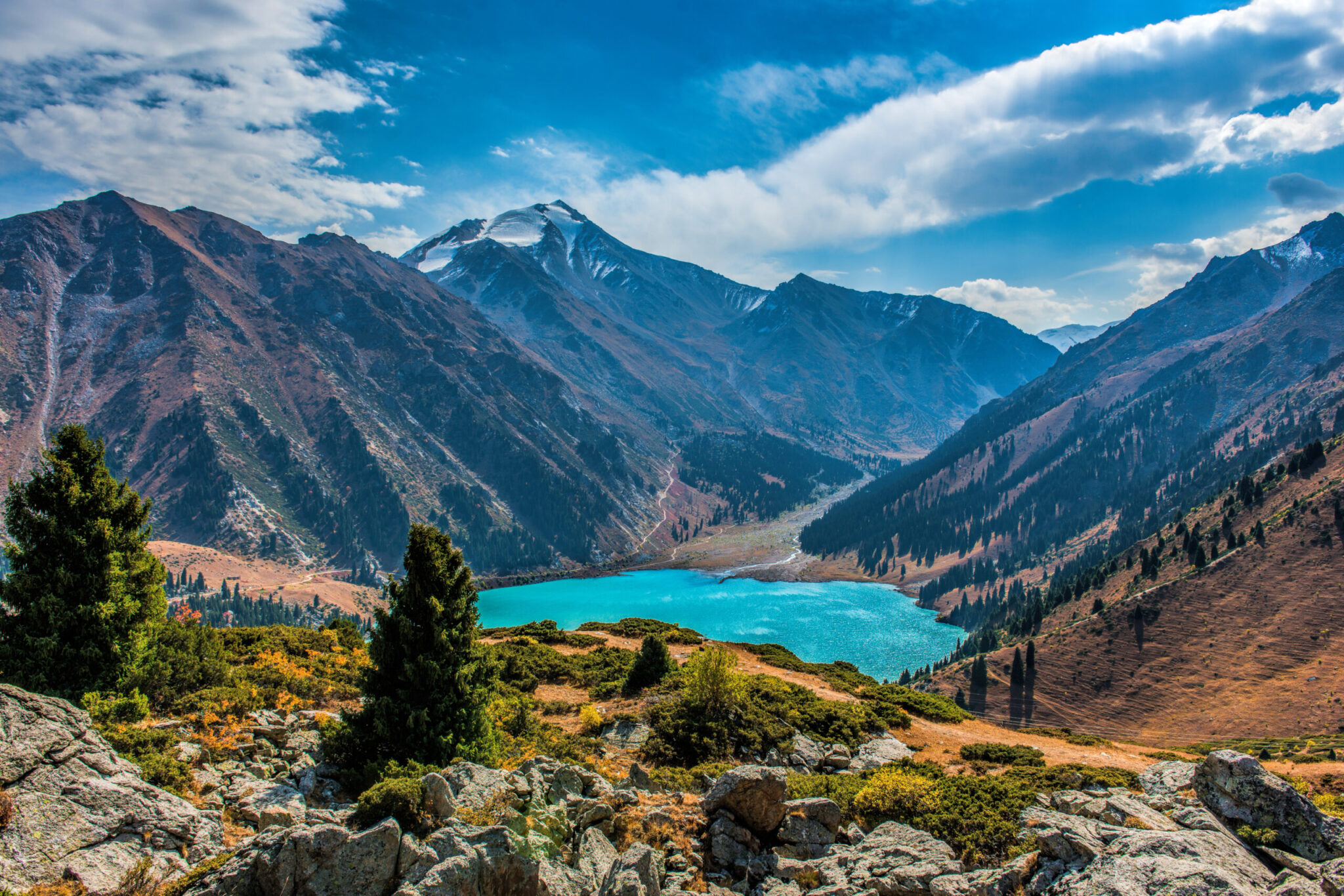
An hour of switchbacks up a different valley to a turquoise glacial reservoir at 8,200 feet (2,500 m), sitting in a bowl below peaks. There is an observatory on the road above it and a checkpoint beyond that, because the ridge behind the lake is the Kyrgyz border.
Two honest notes. Swimming is not permitted, because it is a drinking water reservoir for the city, and the colour depends entirely on the light and the season, at its best from late June to September. It is a short visit rather than a walk, and it is worth it.
Evening
Come down and do very little. This has been a day between 2,600 and 10,500 feet.
Day three: the slow day
The day most itineraries delete, and the one that makes people like Almaty.
Morning: coffee and the streets
Almaty has a specialty coffee culture that is entirely genuine. There are small roasters on residential streets in the Medeu and Bostandyk districts, competent baristas, and cafes full of people working. It is a young city, English is common among people under thirty, and this is the easiest place in the country to have a normal conversation with a local.
Walk Panfilov Street, which is pedestrianised, and look at the Soviet modernist buildings: the Hotel Kazakhstan with its crown, the Palace of the Republic, the Wedding Palace. It is a strong twentieth-century architectural identity currently being knocked about by development, and worth an hour with someone who can point at it.
Afternoon: Kok Tobe
The hill directly above the city, reached by a cable car from the centre in about eight minutes. At the top there is a TV tower, a viewing terrace, a small fairground, some restaurants and a statue of the Beatles.
We will be straightforward about this one. Kok Tobe is not a serious sight and the attractions at the top are ordinary. What it is is the best view of the city against the mountains, particularly in the last hour of daylight, and an eight-minute cable car ride that children love. Go up at five, stay for the light, come down. Do not build a morning around it.
Evening: the last dinner
Go back to the district you liked best on day one, and book the restaurant you walked past.
The fourth day question: Charyn
Almost everyone asks, so here is the honest answer.
Charyn canyon is about 125 miles (200 km) east, three to three and a half hours each way, and the Valley of Castles is walked end to end in about ninety minutes. As a day trip from Almaty that is seven hours of driving for two or three hours in a canyon, arriving in the middle of the day when the light is flat and directly overhead.
If Almaty is your whole trip, it is a tolerable day and we will build it, leaving at seven so you get there before the worst of the heat and the coaches.
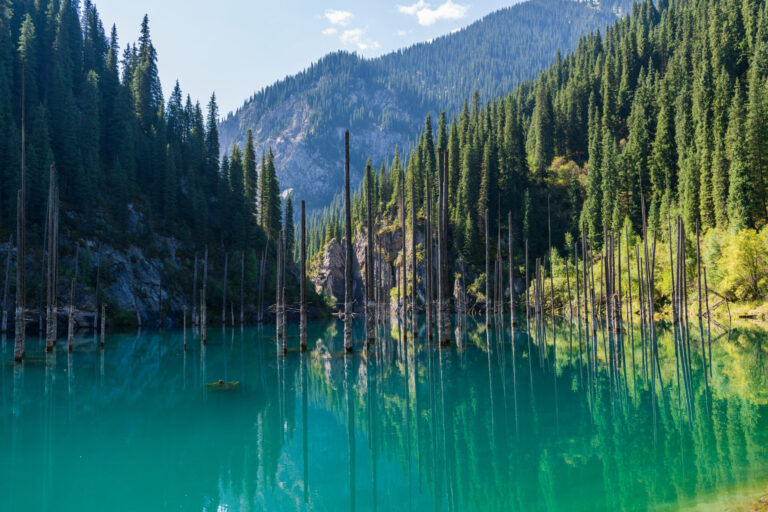
If you have more days than three, do not do it as a day trip. Drive out after lunch, walk the canyon in the late afternoon light, and continue two hours to Saty for the night. That puts you at Kaindy lake at eight the next morning and the Kolsai lakes with a whole day in front of you, and converts the same two places into the best forty-eight hours of a Kazakhstan trip. The case is in walking the Kolsai lakes and Kaindy and in what we would skip in Kazakhstan.
The three days at a glance
| Day | Morning | Afternoon | Evening |
|---|---|---|---|
| One | Green Bazaar, then Panfilov Park and Zenkov cathedral | Central State Museum, then the Arasan baths | A booked restaurant |
| Two | Medeu and the Shymbulak gondola to 10,500 ft (3,200 m) | Big Almaty Lake at 8,200 ft (2,500 m) | Nothing, deliberately |
| Three | Coffee, Panfilov Street, the Soviet modernist buildings | Kok Tobe cable car for the late light | The restaurant you walked past |
What three days here costs
Land only, per person, two sharing, excluding international flights.
| Style | Per day | 3 days |
|---|---|---|
| Careful | $125 | $375 |
| Comfortable | $200 | $600 |
| Boutique | $330 | $990 |
| Luxury | $560 | $1,680 |
Almaty is one of the few places in Kazakhstan where the boutique tier buys something real: the city has genuine design hotels and there are mountain lodges in the trees above it. Our boutique route is built around the handful of places where that is true.
Related
- Kazakhstan: the complete guide to planning your trip
- What to eat in Kazakhstan, and where
- Kazakhstan for the first time
- Classic Kazakhstan in 10 days
- All our Kazakhstan trips