Both are wrong in interesting ways. Here is what actually surprises people, in roughly the order it surprises them.
One: the scale, and then the scale again
Every planning mistake here traces back to the map.
Kazakhstan is about 1,050,000 square miles (2,725,000 km2). It is the ninth largest country on earth and larger than all of Western Europe together, with a population of around twenty million. Two towns that look adjacent on a national map are routinely a full day apart.
The number that lands hardest: Almaty and Astana, the two cities almost every itinerary includes, are roughly 750 miles (1,200 km) apart. That is further than London to Vienna. It is a flight of 1 hour 50 minutes, or a full day on the road across flat ground, or an overnight train.
This is not a country you drive around. It is a country you fly across and then enjoy at ground level, region by region. Accepting that early makes every other decision easier, and it is why we plan to a hard rule of two regions in ten days rather than four. The full length-by-length breakdown is in how many days do you need in Kazakhstan.
Two: the driving distances inside a region are long too
Even when you stop flying, the ground is big.
| Leg | Distance | Realistic time |
|---|---|---|
| Almaty to Charyn canyon | About 125 miles (200 km) | 3 to 3.5 hours |
| Charyn to Saty, for the Kolsai lakes | About 60 miles (100 km) | 2 hours |
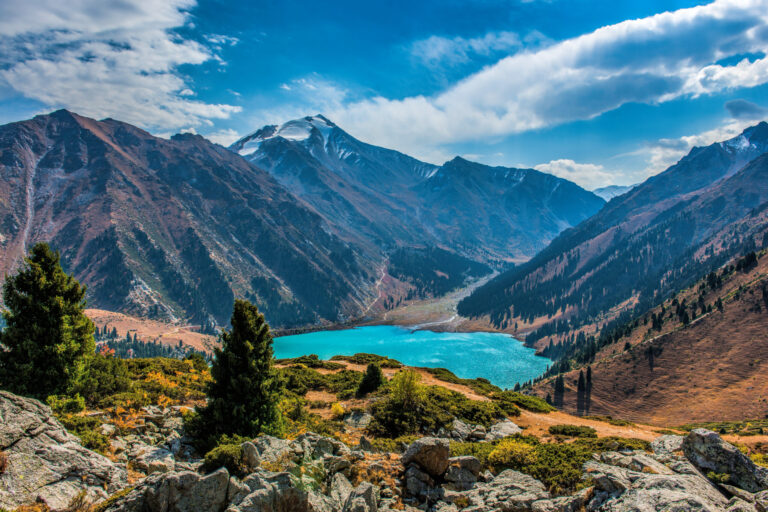
| Almaty to Big Almaty Lake | About 17 miles (28 km) | 1 hour, all uphill |
| Almaty to Altyn Emel park gate | About 155 miles (250 km) | 4 hours |
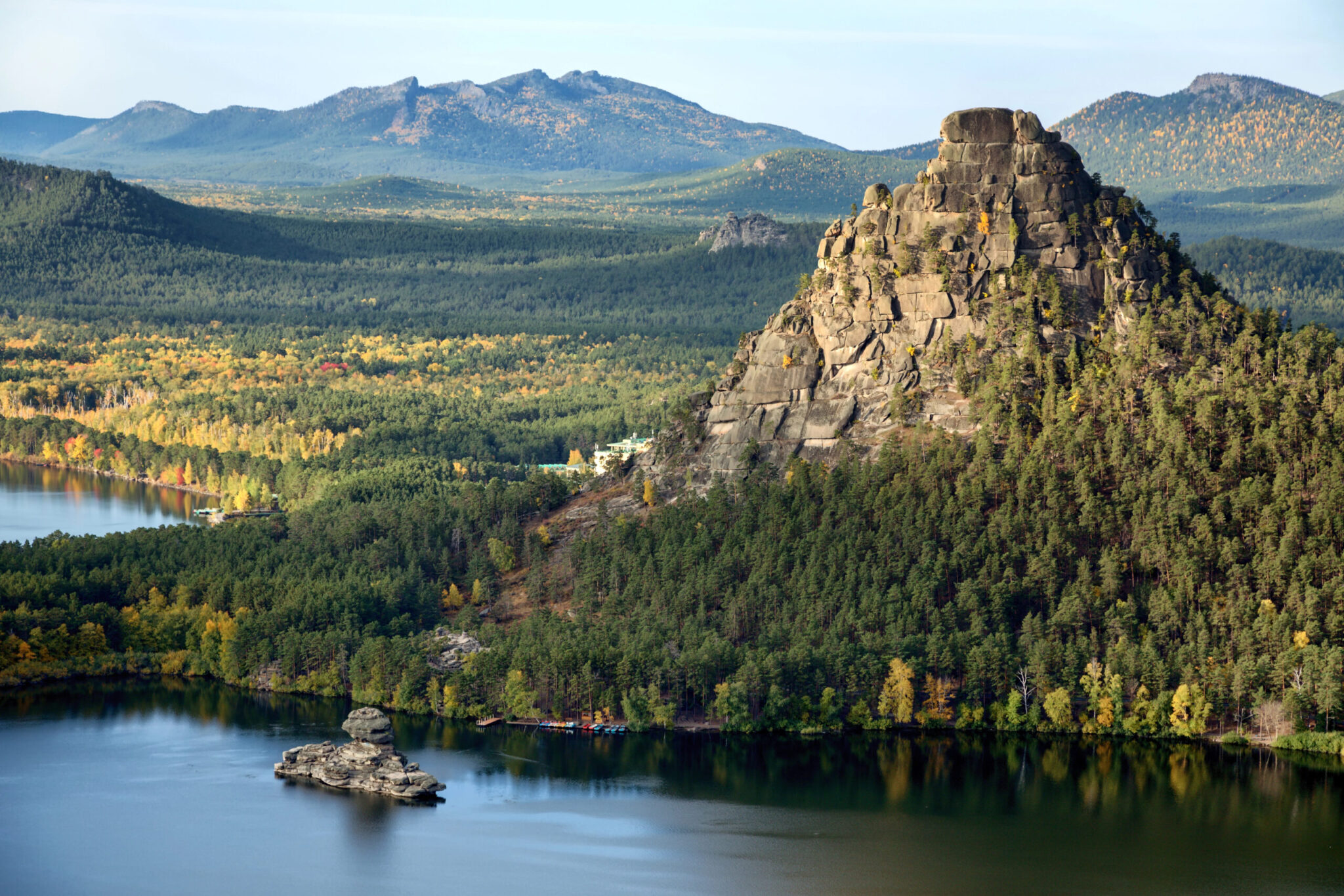
| Astana to Borovoe | About 155 miles (250 km) | 3 hours |
| Aktau to the Bozjyra tract, Mangystau | About 185 miles (300 km) | 5 to 6 hours on track |
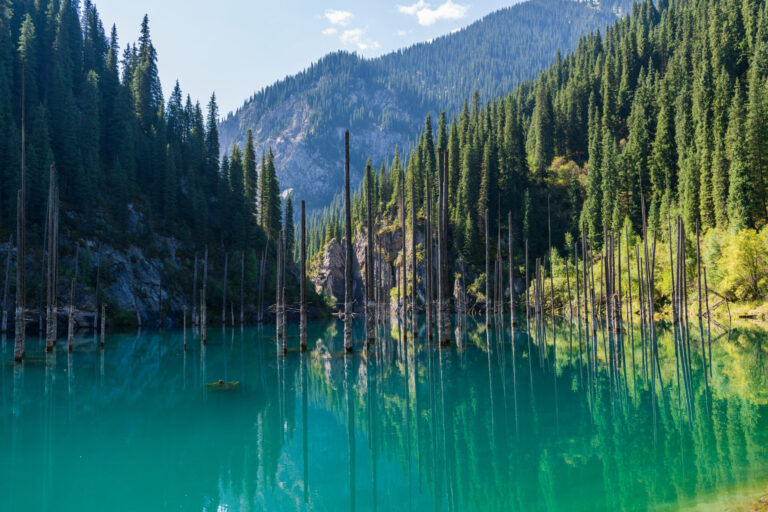
The Charyn and Kolsai line is the one that decides most first itineraries. Every operator in Almaty sells the two together as a single day trip. It is twelve to fourteen hours in a vehicle for a few hours of scenery, and you arrive at the canyon at midday, which is the worst light of the day. One night at Saty, in a simple village guesthouse, turns the same two places into the best forty-eight hours of the trip. We will not build the day-trip version, and the reasons are set out in what we would skip in Kazakhstan.
Three: how modern Almaty is
This is the biggest single surprise and the one people mention first when they come home.
Almaty sits at about 2,600 feet (790 m) with the Trans-Ili Alatau directly above it, peaks over 13,000 feet (4,000 m) visible from the street. It is green, tree-lined, walkable in parts, and full of specialty coffee roasters, natural wine bars, design shops and a modern restaurant scene doing serious work with steppe meat, wild herbs and Caspian fish at a fraction of Western prices.
The city has a real cultural life, a young population that speaks English, and an ordinary contemporary normality that visitors do not expect. It is closer in feel to a mid-sized European city with mountains behind it than to anything in the mental picture most people arrive with. The three-day version is in Almaty in three days.
The corollary is worth saying too: outside Almaty, Astana and Shymkent, the country is much plainer. Village guesthouses are clean, warm and simple, and that is the whole market. There is no luxury tier at Saty or in the desert at any price.
Four: Astana is a different country from Almaty
Astana became the capital in 1997 and has been built almost entirely since. Bayterek tower, the Khan Shatyr tent, Norman Foster’s Palace of Peace and Reconciliation, the Grand Mosque, and a long axis of ministries designed to be photographed.
Some travellers find it genuinely fascinating as a piece of deliberate nation-building, and spend two happy days on it. Others find the scale inhuman and the streets empty and wish they had stayed in the mountains. Both reactions are extremely common and neither is wrong.
We ask which you expect to be before we put two nights in, because we would rather ask than assume. If you came for landscape, the two days are better spent at Altyn Emel.
Five: the food is meat and dairy, and it is better than that sounds
Kazakh food is nomadic food. Beshbarmak, boiled meat with flat noodles in onion broth, is the national dish and is eaten communally from a shared platter. Kazy, horse sausage, is genuinely good and worth ordering rather than avoiding. Baursak, fried dough pieces, arrive with everything.
Then there is the layer people do not expect: the Uzbek and Uyghur south brings plov, hand-pulled laghman noodles, manti and samsa baked on the wall of a tandyr oven, and Almaty also has excellent Korean food from the Koryo-saram community deported to Kazakhstan in 1937. The full guide, including an honest description of fermented mare’s milk, is in what to eat in Kazakhstan.
Six: it is cheaper than you think, except for the hotels
Food, taxis, guides, entries and domestic flights are all inexpensive by Western standards. A bowl of laghman is four to seven dollars. A licensed guide for a full day is seventy to a hundred and twenty. An Almaty to Astana flight is often under a hundred dollars.
The exception is city hotels. Almaty and Astana have full international business hotel markets with international prices, and that single line is most of the gap between our careful tier at $125 per person per day and our comfortable tier at $200. Boutique is $330 and luxury $560, all land only. The full arithmetic is in what a trip to Kazakhstan costs.
Seven: two languages, and English is thinner than you expect
Kazakh and Russian are both in everyday use. Russian is what you will hear most in Almaty, Astana and the north, Kazakh more in the south. English is common among young people in Almaty and thin almost everywhere else, including with drivers.
This is not a country where you get far on English signage in a rural area, which is one of the reasons we use a driver rather than recommending self-drive.
Eight: altitude is present but not a problem
Nothing on a standard Kazakhstan route requires acclimatisation. Big Almaty Lake at 8,200 feet (2,500 m) and the passes above the Kolsai lakes at over 9,800 feet (3,000 m) are high enough that some people notice shortness of breath on a climb. That is the extent of it.
Nine: the weather is continental, which means extremes
Almaty in July sits in the eighties and nineties Fahrenheit (high twenties to mid thirties Celsius). Astana in January regularly sits at -22°F (-30°C) with wind across open steppe, which makes it one of the coldest capitals in the world.
There is no soft way to describe the second number, and the practical consequence is that winter in Kazakhstan is an Almaty and skiing trip rather than a country trip. What each month gives you is set out in Kazakhstan month by month.
What we would tell a friend booking their first trip
Ten days. Two regions. Fly between them. Give Almaty three nights rather than two, because you will like it more than you expect. Put a night at Saty in whatever else you cut. Decide honestly whether you are an Astana person before you commit two days to it. And go in September if the calendar allows it.
That shape is our classic ten-day route, and it is the one we would book ourselves.
Related
- Kazakhstan: the complete guide to planning your trip
- How many days do you need in Kazakhstan?
- Almaty in three days
- What to eat in Kazakhstan, and where
- All our Kazakhstan trips