People who give Bangkok one night come home saying they did not like Bangkok. People who give it three tend to name it as their favourite part of the trip. The difference is not what they saw, it is that the city only starts making sense once you have stopped moving through it.
Bangkok is not a city you tour. It is a set of neighbourhoods that are each about the size of a small town, separated by traffic that will take an hour to cross. So the way to organise three days here is one area at a time, using the river and the metro rather than the roads, and accepting that you are not going to see all of it.
The rule that governs everything: the roads do not work
Bangkok traffic is not a rush-hour phenomenon. A cross-city car journey at four in the afternoon can take ninety minutes to cover 4 miles (6 km). Every itinerary that bounces between the old city and Sukhumvit twice in a day is a bad itinerary regardless of what is on it.
Three things move you properly:
The river. The Chao Phraya express boats are public transport, they cost under a dollar, and they run from Sathorn pier past most of the old city. The orange-flag boat is the workhorse. Using the river as transport rather than as a sunset cruise is the single biggest improvement most visitors can make to their Bangkok days.
The BTS Skytrain and the MRT metro. Clean, cheap, air-conditioned and above the traffic. They do not reach the old city, which is precisely why the river matters.
Walking, in the right hours. Before ten and after five. In between, Bangkok in March or April runs around 95°F (35°C) with humidity that makes it worse, and walking is not a pleasure.
Day one: the old city, Rattanakosin, and then the river
Start at eight. This is not negotiable and it is the difference between a good day and a hot queue. The Grand Palace opens early, the tour groups arrive from about half past nine, and by eleven the courtyards are full and unshaded.
The Grand Palace and Wat Phra Kaew. An hour and a half. Shoulders and knees covered, enforced at the gate, and the rental sarong queue is long and hot. It is genuinely extraordinary and it is also the busiest place in Thailand.
Wat Pho, ten minutes’ walk. The reclining Buddha, the massage school, and courtyards that are calmer than the palace. Better than the palace, in our view, and almost nobody says so.
Cross the river to Wat Arun on the two-minute ferry from Tha Tien pier. Climb the central prang, which is steeper than it looks, for the view back across the water.
Then stop. By one in the afternoon you have done the three biggest things in the old city and you should be indoors. Lunch, hotel, pool, and out again at five.
Late afternoon: the express boat north to Thewet, or a walk through the amulet market and the flower market at Pak Khlong Talat, which runs all night and is at its best after dark.
This is the day we would take a guide for, and the only one. A licensed private guide with a car runs $130 to $200 for the party for a full day, and in the old city a good one changes what you understand rather than just telling you where to stand.
Day two: Chinatown and Talat Noi
Yaowarat, Bangkok’s Chinatown, is the best eating street in the country and it is a night activity. So day two starts slowly.
Morning: Talat Noi, the old riverside quarter just south of Chinatown, on foot. Engine-part workshops, Chinese shrines, a Portuguese church, and lanes barely wide enough for a scooter. It is the best walking neighbourhood in Bangkok and it takes about two hours.
Or: the Jim Thompson House, a set of teak houses assembled by the American who rebuilt the Thai silk industry and then disappeared in Malaysia in 1967. Small, shaded, well presented, and about an hour.
Middle of the day: indoors. The Bangkok Art and Culture Centre, or a mall, and we are entirely serious about the mall. Bangkok’s malls are a civic institution, the food halls are excellent and cheap, and at two in the afternoon in April they are the correct place to be.
Evening: Yaowarat on foot from about six. Grilled river prawns, guay jab peppery rolled noodle soup, oyster omelettes, roast goose, and a queue at every stall worth eating at. Go on a weekday. Saturday is a crush.
What to order is set out in what to eat in Thailand, and where.
Day three: the other side, and whichever Bangkok you want
Day three is the flexible one and there are three good versions.
The Thonburi version. Cross the river and stay there. The Bang Krachao green loop, a near-island in a bend of the Chao Phraya that is mostly mangrove and market gardens, with bicycles and raised concrete paths. It is fifteen minutes from central Bangkok by boat and it feels like a different country. Half a day, morning, with the Bang Nam Pheung floating market at a weekend.
The museum version. The National Museum, which is under-visited and holds the best of Thai art, followed by the Museum of Siam, which is the most intelligent introduction to Thai identity anyone has built. Both are indoor, both are cool, and together they are a good use of a hot day.
The market version. Chatuchak, at a weekend only, which is fifteen thousand stalls and genuinely overwhelming, best from eight until eleven before the heat. Or Wang Lang market on the Thonburi side, which is where Bangkok eats when there are no visitors around, and takes an hour.
Evening: one rooftop, chosen for the view rather than the name, or a Muay Thai night at Rajadamnern or Lumpinee stadium, which is a real sport with a real crowd rather than a show.
Where to stay, and it matters more here than in most cities
Because the traffic decides your days, the neighbourhood decides your trip.
Riverside, around Sathorn and the old Oriental stretch: the best base for a three-day first visit. You are on the express boat line, which reaches the old city without touching a road, and the hotels here are the good ones.
Old city, around Phra Nakhon: small hotels, quiet at night, walking distance to the palace and Wat Pho, no metro. Excellent for two nights if the old city is your priority.
Sukhumvit: the international district, on the Skytrain, good restaurants, and about forty-five minutes from everything in this article. It is where most first-time visitors are booked and it is the least interesting of the three.
Silom and Bang Rak: the best compromise. Metro, Skytrain, the river pier at Sathorn, and Bang Rak’s own street food.
What we would skip
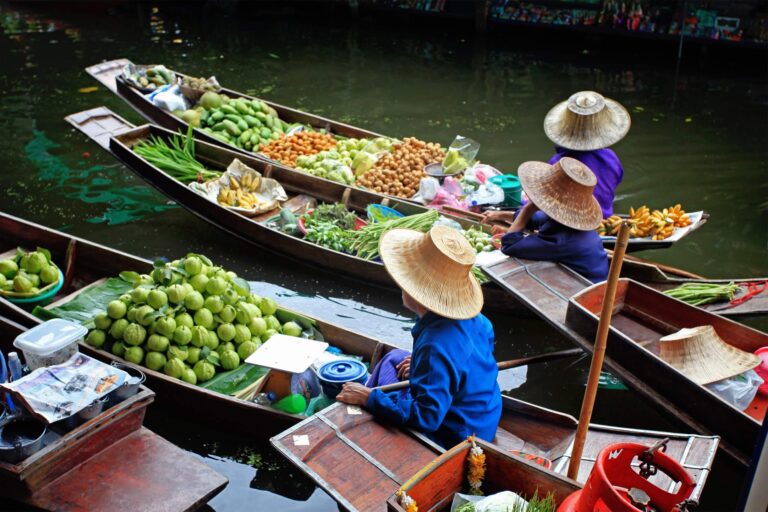
The floating markets at Damnoen Saduak. Two hours each way for a souvenir market on water. Amphawa on a weekend late afternoon is a genuine local market with good grilled seafood, and even that is optional. See what we would skip in Thailand.
Khao San Road, unless you specifically want it. It is a well-run entertainment street with a long history and it has almost nothing to do with the rest of the city.
Any tuk-tuk that offers a fixed-price city tour. It ends at a gem shop or a tailor, every time.
The dinner cruises. The food is buffet-quality, the boat is loud, and the same river costs under a dollar on the express boat.
How Bangkok fits into a two-week trip
Three nights at the start, before the domestic flight, is our default. Jet lag makes the first day slow, and Bangkok is a good city to be slow in. We set out the reasoning in the best two-week route through Thailand, and classic Thailand in 14 days is that route written day by day.
If you are returning through Bangkok at the end, one extra night before an international departure is worth having and it can absorb the things day three did not reach.
Plan this trip
Tell us your dates and the places you want to see, and we build your trip as a $39 day-by-day plan, with recommended hotels by level and every transfer set out step by step.
Keep reading
- Thailand: the complete guide to planning your trip
- What to eat in Thailand, and where
- The best two-week route through Thailand
- Food and culture, 13 days
- Classic Thailand in 14 days
- All our Thailand trips