What we can do is tell you which park suits the animal you actually want to see, what each one is like to be in, and what the odds honestly look like across two or three drives.
Choose the animal, not the name
This is the whole decision and most people arrive with it inverted. They have heard of Yala, so they book Yala, and then discover that what they wanted was elephants, which Udawalawe delivers almost every morning of the year.
| If you want | Go to | Realistic expectation |
|---|---|---|
| Elephants, reliably | Udawalawe | Close to certain on a morning drive, year round |
| Leopard, best odds | Yala block 1 | Likely across two or three dry season drives, and crowded |
| Leopard, better experience | Wilpattu | Lower odds, far fewer vehicles, better forest |
| Sloth bear | Wilpattu, or Yala in the palu fruit season | Never likely anywhere, and Wilpattu is the best chance |
| Birds | Bundala or Kumana | Excellent, and almost nobody else is there |
| Big elephant numbers, seasonal | Minneriya or Kaudulla | Likely July to September or October, not before |
| Blue whales | Mirissa or Trincomalee, by season | Good in season, never guaranteed, mornings calmest |
Yala, honestly
Yala has one of the highest leopard densities recorded anywhere in the world. That part of the reputation is true.
Block 1, where almost every visitor goes, is also the most heavily visited piece of protected land in the country. A radio call about a sighting can put a dozen jeeps around one animal within minutes, with drivers competing for position, and the experience of that is not the one in the photograph you were shown. Your leopard odds across two or three morning drives in the dry season are good. Your odds of being alone when it happens are poor.
Two further facts we check for your dates. Block 1 usually closes for several weeks in the driest part of the year, generally September into October, and the exact dates are published each year rather than fixed. And the other blocks, 3 and 5, are quieter and less productive, which is the trade in the other direction.
We still book Yala, often. It is the right answer for someone whose priority is seeing a leopard, who has two mornings, and who would rather have the sighting with company than a quiet morning without one. We just say the second half of that sentence out loud first.
Wilpattu, which we recommend more often than people expect
Wilpattu is the largest national park in Sri Lanka, on the northwest coast, and it is a different kind of place: mature forest rather than scrub, with a system of natural sand-rimmed lakes called villus that the animals come to.
Fewer vehicles, by a wide margin. Longer distances between sightings. Better birds, a real chance of sloth bear, and leopard odds that are genuinely lower than Yala’s but not by as much as the reputation suggests. What you notice most is that you spend the morning in a forest rather than in a queue.
Geographically it suits a route that runs through Anuradhapura, which makes it a natural pairing with the cultural triangle rather than the south coast. That is why it appears in Deep Sri Lanka in 21 days and not in every twelve-day trip.
Our own preference, for most clients: Wilpattu if you have three or more safari drives in the trip, Yala if you have two and the leopard is the point.
Udawalawe, the best first safari
Udawalawe is where we send most people who have not done this before, and it is frequently the drive they enjoy most.
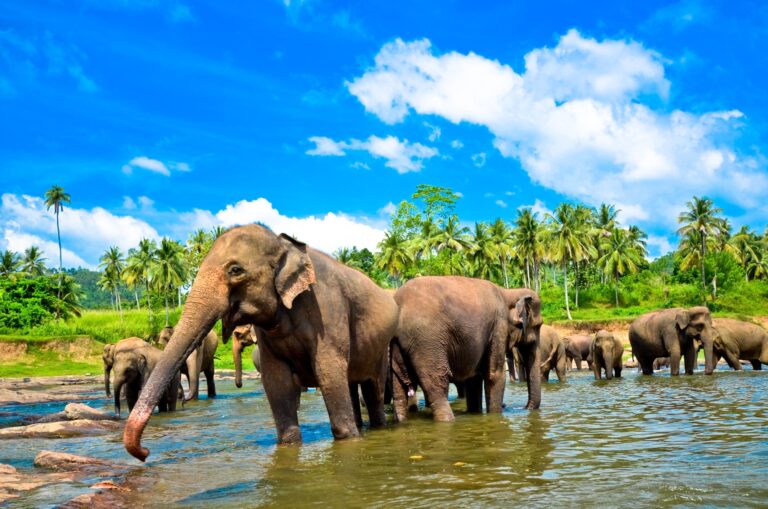
Elephants are close to certain on a morning drive, all year, in open grassland where you can watch a family group for twenty minutes rather than glimpse something in scrub. There are no leopards to compete for, so nobody is racing. It is two to three hours from the hill country, which fits the standard route, and it is materially cheaper than Yala.
The honest caveat: it is grassland and reservoir rather than forest, so it is less atmospheric than Wilpattu, and once you have watched elephants for two hours you have seen the park. One drive is enough here, where two or three are needed elsewhere.
Minneriya, Kaudulla and the gathering
In the driest months, usually July through September or October, elephants congregate in large numbers on the receding grasslands of the Minneriya and Kaudulla reservoirs. It is one of the largest gatherings of Asian elephants anywhere and it is genuinely remarkable.
Two honest qualifications. We will not sell it outside its season, because outside the season it is a normal park with normal numbers. And inside the season we call it likely rather than certain, because the herds move between the two reservoirs depending on where the water has dropped, so the right answer on the day is decided by the ground team that morning rather than by the itinerary printed in March.
Kumana and Bundala, for people who like birds
Kumana, on the east side of the same block of protected land as Yala, is a bird park with occasional leopards and almost no vehicles. Bundala, on the south coast, is lagoons and waders, with flamingos in the northern winter.
Neither will produce the photograph your friends expect. Both are better mornings than a crowded block 1 drive if what you like is being outside quietly.
How we build a safari day
- Morning drives, always, where a choice exists. Cooler, more active animals, better light.
- Two nights at a park, not one. That gives you two mornings, which roughly doubles your chances of everything.
- A private jeep rather than a shared one where the budget allows, because it decides your pace and stops the vehicle being driven to somebody else’s photograph.
- Booked directly, not through the hotel desk, which is where the price and the driver quality both slip.
- Cost, as guidance: park entry plus jeep and tracker works out at roughly $50 to $90 per person for a shared jeep on a half-day drive, more for a private vehicle. Fees have risen more than once and we confirm the current published figures for your dates. The full budget picture is in what two weeks in Sri Lanka costs.
What we do not book
The elephant orphanage on the Kandy road. It is on most group itineraries and it is not on ours, and your proposal will say why.
Roadside turtle hatcheries. Tanks of hatchlings held past the point they should have been released, for a photograph. For turtles we use the community night watch at Rekawa in season, which is the real thing and involves sitting in the dark being quiet.
Any operator who guarantees a sighting. Including the ones who guarantee it verbally at the gate and then drive badly to try to deliver it.
Whale watching with the cheap boats, which chase and crowd. Blue whales pass Mirissa roughly December to April and Trincomalee roughly May to September, sightings are good in both windows and guaranteed in neither, and we use operators who keep their distance.
Plan this trip
Tell us your dates and the places you want to see, and we build your trip as a $39 day-by-day plan, with recommended hotels by level and every transfer set out step by step.
Keep reading
- Sri Lanka: the complete guide to planning your trip
- The best two-week route through Sri Lanka
- Which month to visit Sri Lanka, and why it depends on the coast
- What we would skip in Sri Lanka
- Deep Sri Lanka, 21 days
- Sri Lanka, planned around the monsoon that actually matters