The best time to visit Sri Lanka depends on which coast you want, because the island has two monsoons that arrive on opposite sides at opposite times of year. That single fact decides the shape of a trip to Sri Lanka: your dates do not decide whether you can go, they decide which half of the island you go to.
In short: the west and south coasts (Colombo, Galle, Mirissa) and the western hills are at their best from December to March, often into early April. The east coast (Trincomalee, Pasikudah, Arugam Bay) and the north are at their best from about May to September, while the southwest monsoon rains on the other side. The hill country around Kandy, Nuwara Eliya and Ella is good from January to March, and its eastern side, Ella included, also works well in the dry summer months. October and November are the hardest weeks, with unsettled weather on both coasts at once.
Who this is for: travellers choosing dates for a first or second Sri Lanka trip of 10 to 16 days, and anyone with fixed dates who wants to know which side of the island to build around.
Updated October 2026 · May Ast, Sri Lanka travel consultant, Go East Travel
Why does the best time to visit Sri Lanka depend on the coast?
Because the rain changes sides. The southwest monsoon soaks the west and south coasts and the western hills from roughly May to September. The northeast monsoon soaks the east, the north and the eastern hills from roughly December to February, with heavy rain often starting in late October. There is no month when the entire island is dry, and any answer that gives you one set of months for the whole country is simplifying something that matters.
Sri Lanka’s Department of Meteorology divides the year into four seasons, and its 30-year averages show where the rain actually falls in time (Department of Meteorology, Sri Lanka, 1961-1990 climatological averages, checked October 2026):
| Season | Months | Island average rainfall | Share of the year’s rain | Where it hits hardest |
|---|---|---|---|---|
| Northeast monsoon | December to February | 479 mm | 26% | East coast, north, eastern hills |
| First inter-monsoon | March to April | 268 mm | 14% | Afternoon thunderstorms, mainly southwest and hills |
| Southwest monsoon | May to September | 556 mm | 30% | West and south coasts, western hills |
| Second inter-monsoon | October to November | 558 mm | 30% | Much of the island, both sides |
Look at the last row. The second inter-monsoon brings as much rain in two months as the southwest monsoon brings in five. That is the number behind our advice on October and November further down. March and April, by contrast, carry the smallest share of the year’s rain, which is why they sit inside the window that works almost everywhere.
Which month is good for which region?
Read this by column: the question is never “is March good” but “is March good where I want to be”. The ratings are our own, from the trips we plan and the feedback travellers bring back, set against the seasons above.
| Month | South and west coasts | Cultural triangle | Hill country | East coast | North, Jaffna |
|---|---|---|---|---|---|
| January | Excellent | Good | Good, cold nights | Wet | Wet, easing |
| February | Excellent | Excellent | Excellent | Improving | Improving |
| March | Excellent | Excellent, hot | Excellent | Good | Good |
| April | Good to mid-month | Very hot | Good | Good | Good |
| May | Monsoon arrives, rough sea | Workable, humid | Wet in the west | Good | Good |
| June | Wet, dangerous currents | Workable | Wet in the west | Very good | Very good |
| July | Wet, dangerous currents | Good, dry zone | Wet in the west | Excellent | Excellent |
| August | Wet, dangerous currents | Good, dry zone | Wet in the west | Excellent | Excellent |
| September | Easing late | Good | Improving | Very good, easing late | Very good |
| October | Unreliable, both sides | Wet | Wet | Monsoon arrives | Monsoon arrives |
| November | Unreliable, both sides | Wet | Wet | Wet | Wet |
| December | Good, improving | Good | Good | Wet | Wet |
The cultural triangle sits in the dry zone. Anuradhapura, Polonnaruwa, Sigiriya and Dambulla are less monsoon-driven than either coast, which is why a June or July trip built around the ancient cities, the eastern side of the hills and the east coast works well while the south is being rained on.
The sea matters more than the rain. On the monsoon-side coast the problem is rarely that you get wet. It is that the sea turns rough and the rip currents are genuinely dangerous. A wet afternoon is an inconvenience; a red-flagged beach for ten days is the holiday gone.
October and November are the weeks we push people out of. The second inter-monsoon can put rain and unreliable sea on both sides at once, and November into December is also when the Bay of Bengal cyclone season can reach the island. Cyclone Ditwah in November 2025 is the recent reminder. Prices are low for a reason.
What is the weather like in the hill country?
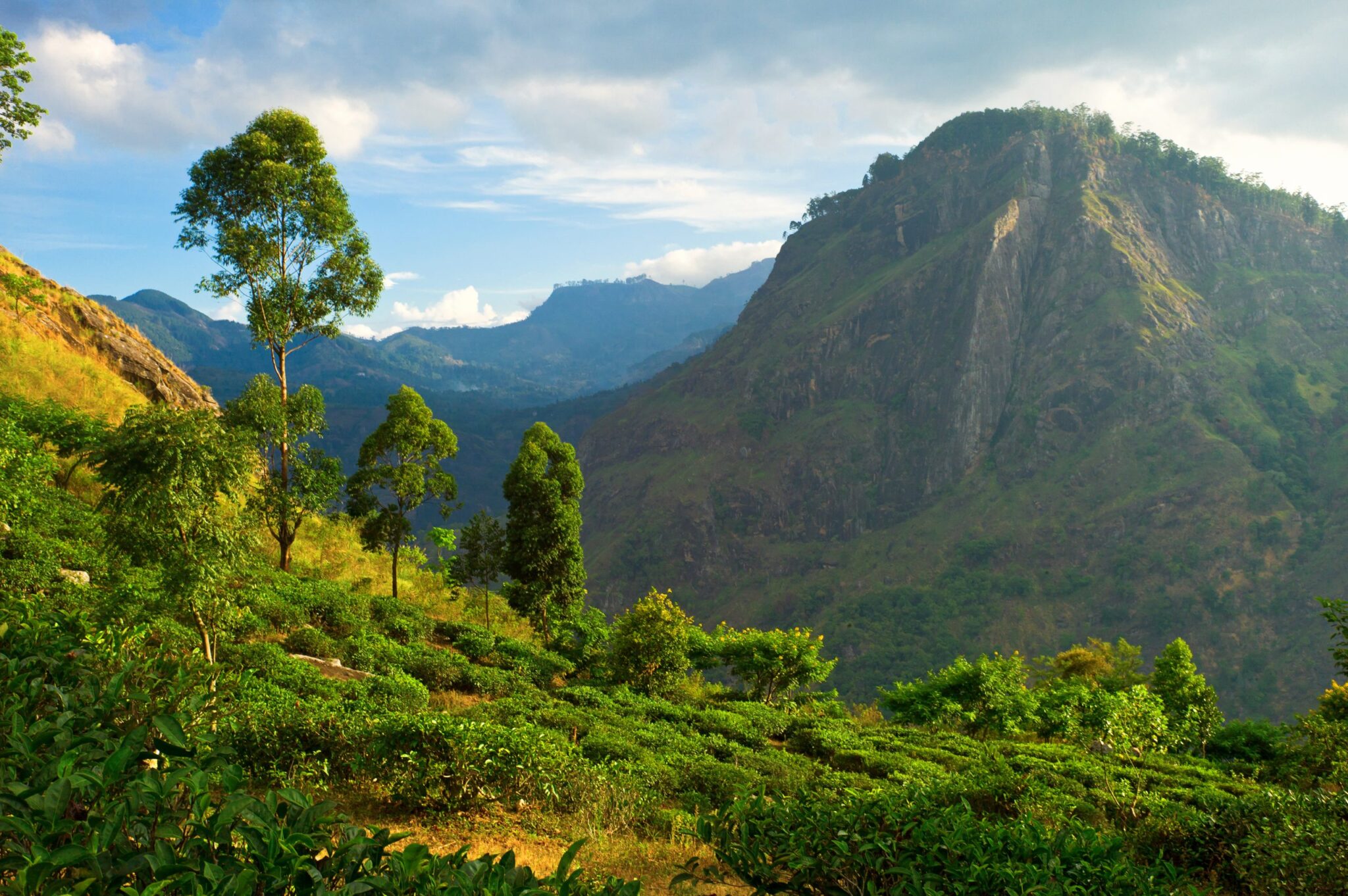
Cooler, wetter and more local than anywhere else on the island. Nuwara Eliya sits at close to 1,900 metres and nights there can be properly cold from December to February, so a fleece is not optional. Kandy, lower down, is warm and humid most of the year.
The hills also split by side. The western slopes, around Hatton, Adam’s Peak and the tea estates facing Colombo, take the southwest monsoon from May to September and spend a lot of those weeks inside cloud. The eastern side, around Ella, Haputale and Badulla, is drier in those months and wetter from about October to January. So an Ella stay in July is a reasonable plan, while a night near Adam’s Peak in July is mostly a night in fog. The Adam’s Peak pilgrimage season, when the path is lit and the tea houses on the climb are open, runs roughly from December to May.
Is the Kandy to Ella train running, and does the season matter?
Only part of it, as of October 2026. The Kandy to Nanu Oya section of the hill country line has been closed since Cyclone Ditwah in November 2025, and trains have run again between Nanu Oya and Badulla, through Ella, since June 2026. In practice we drive you from Kandy to Nanu Oya through tea country and put you on the train there, which keeps the stretch with the views. Sri Lanka Railways has not published a reopening date for the closed section; we treat it as open only when the official timetable shows the trains (Sri Lanka Railways, checked October 2026).
The season changes the views more than the ride. Between May and September the high stretch of the line around Nanu Oya and Pattipola is more often in mist, and the carriage is the same either way. Getting a reserved seat is the harder problem in any month, and it has its own article: the Kandy to Ella train, what is running and how to get a seat.
Which festivals and seasonal events should shape your dates?
A few things happen on their own calendar and can be worth building the trip around, or worth avoiding.
- The Esala Perahera in Kandy, usually in July or August, ten nights of processions that fill the city entirely. The dates follow the lunar calendar and change every year: the 2025 festival began in late July, the 2026 one ran in August. The 2027 dates were not published as of October 2026; they are usually announced in June or July. Hotels in Kandy for the final nights book many months ahead, so this is either the reason for your dates or a thing to plan around.
- The Sinhala and Tamil New Year, usually around 13 and 14 April, when the country stops. Poor timing for covering ground.
- Poya days. Every full moon is a public holiday, with no alcohol sold and religious sites at their busiest and most interesting. Vesak, the full moon in May, is the largest, with lanterns and roadside food stalls across the country.
- Blue whales off Mirissa, roughly December to April, and off Trincomalee roughly May to September. Good sightings in both windows, guaranteed in neither, and mornings are calmer.
- The elephant gathering at the Minneriya and Kaudulla reservoirs in the driest months, usually July through September or October. We call it likely rather than certain even in season, because the herds move between reservoirs depending on where the water has dropped, and we will not sell it outside the window at all.
- Arugam Bay’s surf, roughly April or May to September or October, the opposite of the south coast’s calm season.
- Yala’s block 1 usually closes for several weeks in the driest part of the year, generally September into October. We check your dates against the closure that is actually published for your year rather than last year’s. If wildlife is the point of the trip, Yala or Wilpattu compares the two parks.
What does a wrong-month trip actually look like?
Usually it is fine, if the route is flipped. A traveller with fixed dates in July who is set on Galle, Mirissa and Unawatuna is planning a disappointing holiday. Grey days, a sea that lifeguards keep people out of, and half the beach restaurants at half strength.
The same traveller, same dates, sent instead to the cultural triangle, Kandy, the eastern hills, Trincomalee and Arugam Bay, often has a better holiday than the December version of themselves, in reliable sunshine, on emptier beaches, at noticeably lower prices, with the elephant gathering happening while they are there. That is our east coast and Jaffna route, and it exists for exactly this.
So a wrong-month Sri Lanka trip is only a wrong-month trip if the route is not flipped, and the flip has to happen at the planning stage, not on day four when it becomes obvious.
The real exceptions, where we will tell you the month is genuinely difficult rather than merely different:
- October and November, where there is no dry side to flip to. We still build good trips in these weeks, weighted to the cultural triangle and the hills, and the plan says plainly what you are accepting in exchange for the low rates.
- A trip that must include a specific south coast villa in July, or a specific east coast resort in December. Some properties simply close in their off season.
- A fixed date in the New Year week around 13 April, if the plan involves moving between four places.
Which months would we choose, given the choice?
February and March. Our own answer. The south, west, hills and cultural triangle are all good at once, the east is workable, the sea is calm, and by March the Christmas crowds and rates have gone. Late March and early April are the weeks our own team takes.
July and August, if you want the east. Empty beaches, flat sea, the elephant gathering, and the strong likelihood that you will be the only foreign travellers at dinner in Jaffna. Add the Esala Perahera if the year’s dates line up.
December to January if the dates are fixed by school holidays, accepting that Christmas and New Year rates in the hill bungalows and south coast villas are the highest of the year, and that they book six to nine months ahead.
What we would not choose without a reason: October, November, and the week either side of the April New Year. For a two-week shape that works in the main season, see Sri Lanka in two weeks.
What else should you sort out before choosing dates?
The ETA. Every visitor needs an Electronic Travel Authorization before arrival, applied for on the official site eta.gov.lk (checked October 2026). Since 25 May 2026, nationals of 40 countries, including the UK, the US, Canada, Australia, New Zealand, Japan, Germany, France, Italy, Spain and the Netherlands, receive a 30-day tourist ETA with no fee, with double entry allowed within those 30 days. Other nationalities pay the standard ETA fee, and anyone staying beyond 30 days pays for an extension. Check the list for your own passport on the official site, and avoid look-alike agency sites that add a service charge.
Booking lead time. Four to six months is enough for most dates. Six to nine months for Christmas, New Year and the Esala Perahera. Reserved train seats release only about 30 days ahead, whatever the season.
Budget by season. The same hotel can cost noticeably less on its off-season coast. What two weeks costs at different levels is in what two weeks in Sri Lanka costs.
Plan this trip
Tell us your dates and the places you want to see, and we build your trip as a $39 day-by-day plan, with recommended hotels by level and every transfer set out step by step.
Keep reading
- Sri Lanka, planned around the monsoon that actually matters
- Sri Lanka: the complete guide to planning your trip
- Classic Sri Lanka, 12 days
- The east coast and Jaffna, 14 days
- The Kandy to Ella train, and how to actually get a seat
- Monsoon in Asia: which countries it actually ruins