Vietnam is 1,025 miles (1,650 km) long and barely 30 miles wide at its narrowest point. The north has a real winter, cold, grey and damp. The south has no winter at all, only a wet season and a dry one. The centre runs its own calendar again and floods in exactly the months when the rest of the country is at its best. Three regions, three climates, one visa. This is the document our consultants open when a new Vietnam file lands on the desk.
Vietnam at a glance
| Best months overall | February to April, and October to November |
| Comfortable trip length | 12 to 16 days |
| Entry | E-visa in advance, up to 90 days, single or multiple entry |
| Getting around | Domestic flights between regions, private car with driver within them |
| Land budget, per person per day | 110 to 450 US dollars |
| Our presence | Our dedicated local office in Hanoi, covering Vietnam, Laos and Cambodia |
When to travel: three regions, three calendars
The north: Hanoi, the bays, Ninh Binh, Sapa, Ha Giang, Pu Luong
December to February is winter. Hanoi sits around 57 to 68°F (14 to 20°C) and can stay below 50°F (10°C) for days under low grey cloud. The mountains are colder again, occasionally near freezing, and the views can be under cloud for a week. Hotels here are not heated to the standard a European expects.
March and April bring the fine persistent drizzle the Vietnamese call crachin, with mist that sits on the bays and makes the karst either atmospheric or invisible. Temperatures climb into the seventies and eighties Fahrenheit (low to high twenties Celsius). A good window, not a perfect one.
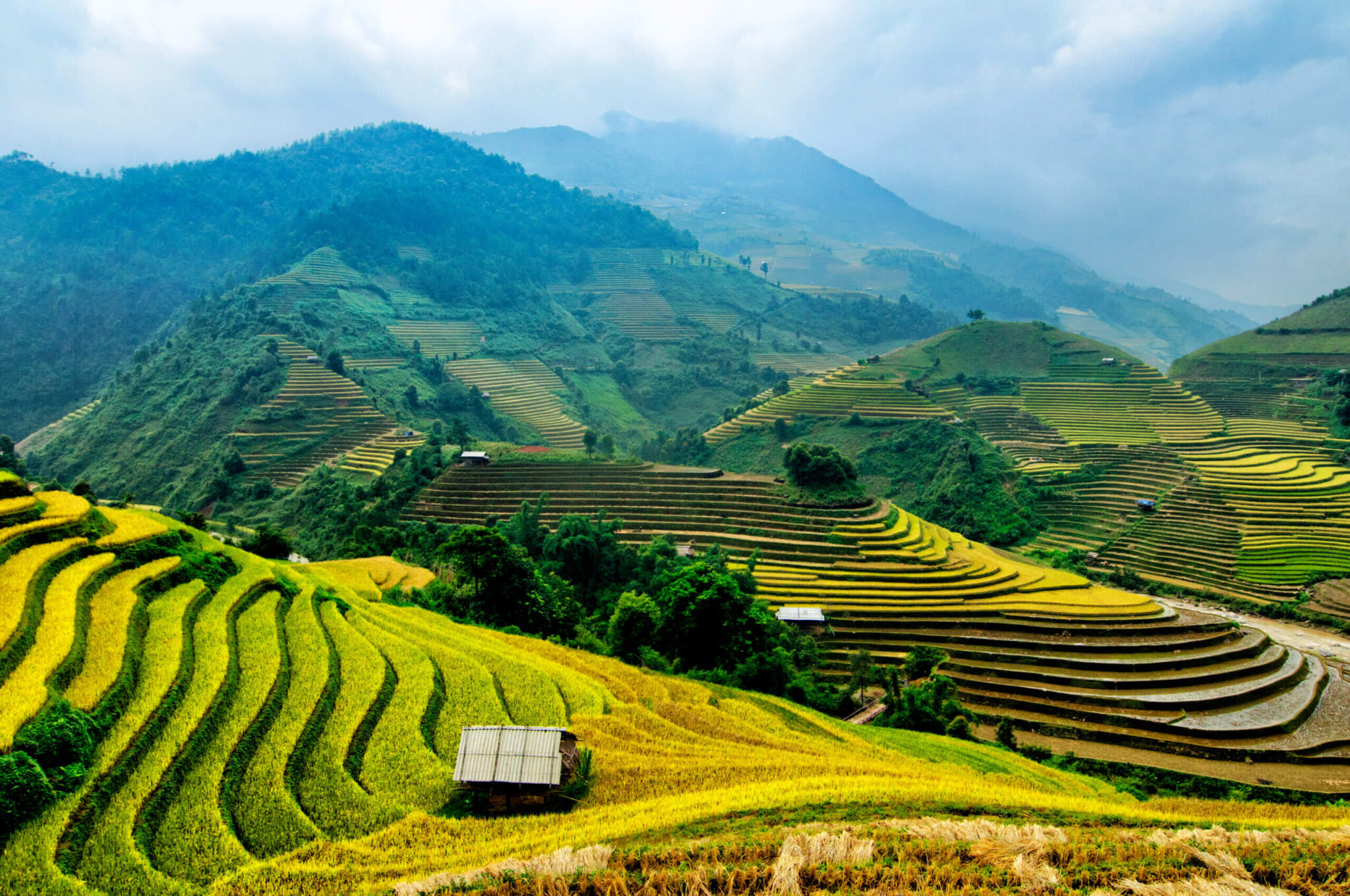
May to September is hot and wet, above 95°F (35°C) in July, with humidity that makes the middle of the day unusable. Rain comes in heavy bursts rather than all day, and typhoons cross the Gulf of Tonkin from July to October and close the bays. The compensation is the rice terraces of the far north, green in June and gold in late September.
October and November are the best weeks in the north, without argument. Dry, clear, in the seventies Fahrenheit (low twenties Celsius), with reliable mountain roads. This is when we send people to Ha Giang.
The centre: Hue, Danang, Hoi An, Phong Nha
February to August is dry and genuinely so. April to June is the sweet spot. July and August are very hot, and the beaches earn their keep.
September to December is the problem window. The coast takes the year’s rain in one concentrated block, typhoons make landfall between September and November, and Hoi An floods. Not metaphorically: the Ancient Town goes under water most years, the shops move stock upstairs and carry on. Roads close and flights into Danang are cancelled. October and November are the worst of it.
This is the awkward fact of Vietnamese planning: the months that are perfect in the north are unreliable in the centre. We deal with it by building the central days so they can move, and by telling you in advance rather than after.
The south: Ho Chi Minh City, the Mekong Delta, Phu Quoc, Con Dao
Warm all year at 82 to 95°F (28 to 35°C). November to April is the dry season and the best time to be here, with March to May the hottest stretch. May to October is wet, but not in the way people fear: a heavy downpour in the late afternoon, then it clears. It rarely wrecks a day, rates are lower and the delta is greenest. Phu Quoc follows the same pattern; Con Dao runs the other way and is best from March to September.
So when should you go?
March or April gives the fewest compromises: the north in its shoulder, the centre dry, the south dry. This is our default recommendation. October or November gives you the best possible north and a real risk in the centre, which we route around, sometimes by putting Hoi An early so a flood has somewhere to move to. If your dates are fixed to June, July or August, we build a different trip: less city, more coast and mountain, early starts, and the far north where the terraces are at their best.
Tet
Vietnamese Lunar New Year moves each year between late January and mid February, and it is the most disruptive thing in the calendar. In the week around it most family-run restaurants close, many shops shut, museums close for several days, domestic flights and trains sell out months ahead at double the price, and staff go home to their villages. The country is not shut, exactly, but it is not open for business either. The days immediately before Tet are genuinely worth seeing; travelling through Tet without knowing it is Tet is a bad holiday. We always tell you where your dates fall. The other domestic peaks are 30 April with 1 May, and 2 September.
How many days do you actually need?
- Under 8 days. One region. Hanoi with a bay, or Ho Chi Minh City with the Mekong and a beach.
- 10 days. North and centre, or centre and south. Hanoi, a bay, Hoi An.
- 12 to 14 days. Hanoi, a bay, Hue, Hoi An, Ho Chi Minh City and the Mekong, with two internal flights. The standard shape, and it does not feel rushed if it is built properly.
- 16 days. The above plus a rest and one of: Ninh Binh, Phong Nha, the Mekong slowly, or a real beach stop.
- 18 to 21 days. Ha Giang, the caves at Phong Nha, Con Dao, or a second country.
The number that matters is not the total, it is the hotel changes. Above one move every two days a Vietnam trip becomes transit, and transfer days here are longer than the map suggests because road speeds are low.
Entry requirements
Almost all visitors apply for a Vietnamese e-visa online before travelling. Since the 2023 change in the law it is open to all nationalities, valid for up to 90 days, and you choose single or multiple entry when you apply. The fee is currently in the region of $25 single and $50 multiple. Official processing is three working days; we allow a week to ten days, because rejections for small errors on the form are common.
Three things worth saying clearly:
- Apply through the official government portal, not a lookalike. The internet is full of agent sites charging four times the fee. We send you the correct link.
- Choose multiple entry if your route leaves Vietnam and comes back. Any itinerary that dips into Cambodia or Laos and returns needs it, and this is the most common expensive mistake we see.
- Some nationalities are exempt for shorter stays, currently 45 days, including several Western European countries. The list changes, so we check your exact passport.
Phu Quoc has a separate exemption for travellers arriving directly and staying on the island. Cambodia is an e-visa or visa on arrival at roughly $30 plus processing; Laos is a visa on arrival at typically $30 to $45. Our Hanoi office handles both.
Getting around
Domestic flights
Unavoidable on any trip covering more than one region. Hanoi to Ho Chi Minh City is two hours in the air and 32 to 35 hours by train, so the choice makes itself. Vietnam Airlines is our default; VietJet is cheaper and workable, but its baggage allowance is genuinely small. On a two-week north to south route you typically fly twice. Flights to Con Dao and Phu Quoc are on turboprops and weather-sensitive, so we never put one on the same day as an international departure.
Trains
The Reunification Express is romantic in principle. In practice most of it is slow, and giving 16 hours of a two-week holiday to a night train is a decision to make deliberately.
One exception is worth building a trip around. The stretch between Hue and Danang, about two and a half hours along the coast and over the Hai Van Pass, is one of the finest short rail journeys in Asia. We book it on almost every itinerary that passes through, on the seaward side.
Private car with driver
The standard way to move within a region. Roads are better than they were, but average speeds are low: Hanoi to the bays is two and a half hours, Hanoi to Pu Luong four, and Hue to Hoi An three if you take the old Hai Van Pass road instead of the tunnel, which you should.
Motorbikes
Roughly 60 million of them are how the country moves. Riding one yourself is a different question: foreign licences are generally not valid without a Vietnamese conversion, and the accident rate is high. On our Ha Giang trips we put you on the back of a bike with an experienced local rider, or in a car. We will not organise a self-drive motorbike trip, and we would rather say so than take the booking.
What a trip to Vietnam costs
Land only, per person, two sharing, excluding international flights. Includes accommodation, food, private ground transport, domestic flights, entries and guiding.
| Style | Per day | 10 days | 14 days | 16 days | 21 days |
|---|---|---|---|---|---|
| Careful: good local 3 star, mostly independent | $110 | $1,100 | $1,540 | $1,760 | $2,310 |
| Comfortable: strong 4 star, guides where they matter | $180 | $1,800 | $2,520 | $2,880 | $3,780 |
| Boutique: the best small hotels in the country | $290 | $2,900 | $4,060 | $4,640 | $6,090 |
| Luxury: top-tier resorts, private guiding throughout | $450 | $4,500 | $6,300 | $7,200 | $9,450 |
Three things move that number:
- Hotels. A pleasant 4 star in Hoi An is $90 a night; a beach villa at the top end is $900. Everything else is comparatively cheap, so hotel tier is most of the conversation.
- The bay. A cabin on a good Lan Ha boat, a private charter and a suite on a six-cabin vessel are three very different prices for what looks on paper like the same night.
- Guiding. A licensed private guide with a car is roughly $80 to $130 a day. We use them on three or four days of a two-week trip, not fourteen.
Cheaper than people expect: food. Pho on a plastic stool is $2, a very good sit-down dinner is $15 to $25 a head, and a glass of bia hoi on a street corner is under 50 cents. The best meals of your trip will not be the expensive ones.
The regions worth your time
Hanoi. Older, denser and stranger than Ho Chi Minh City, and the more interesting of the two. Three nights. The Museum of Ethnology, out in the suburbs, explains the country’s 54 ethnic groups better than anything else in Vietnam, and almost nobody makes time for it.
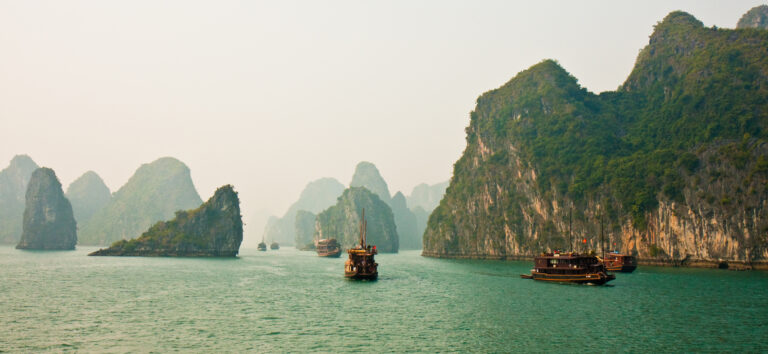
Lan Ha and Bai Tu Long, rather than central Halong. The bays deserve the image everyone arrives with, but the main Halong route carries several hundred boats. Lan Ha, reached via Haiphong and Cat Ba, and Bai Tu Long to the north east are the same seascape with a fraction of the traffic. Two nights on the water beats one, because the first day is mostly transfer.
Ninh Binh. The same karst on land, with rowing boats through flooded caves at Trang An and 500 steps up Mua Cave. An easy overnight from Hanoi, busy enough now that early starts matter. We would skip the huge modern Bai Dinh pagoda.
Pu Luong and Mai Chau. Terraced valleys, stilt houses and water wheels, four hours from Hanoi. The best short walking in the north, with better lodges than the mountains further up.
Sapa and the far north. Sapa town has been overbuilt into something close to a building site, and we say so to everyone who asks for it by name. The Muong Hoa valley below is still beautiful. If you want the north properly, Ha Giang is the answer: a 220-mile (350 km) loop through the Dong Van karst plateau, the Ma Pi Leng pass above the Nho Que river, and markets that are not staged.
Hue. The imperial citadel, the royal tombs along the Perfume River, and the most refined food in the country. Two nights. The dragon boat trip is not the way to see the tombs.
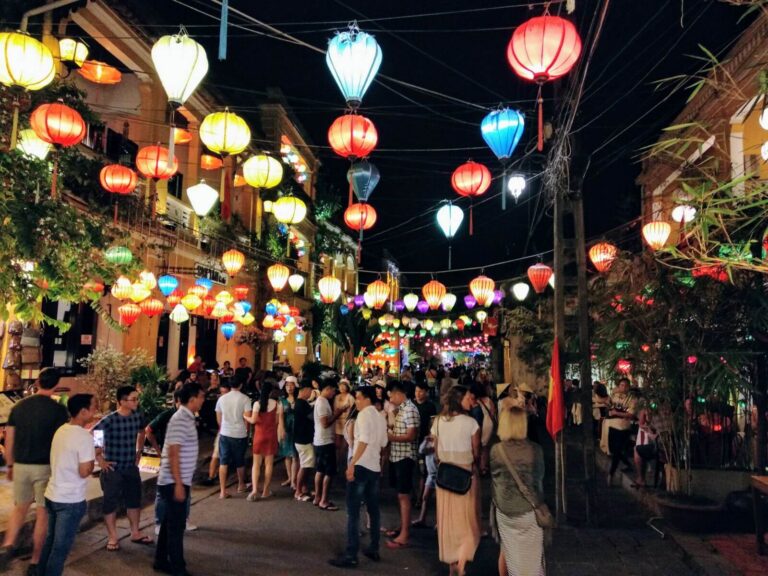
Hoi An. The most charming town in Vietnam and also the busiest. The answer is timing: the Ancient Town at seven in the morning is a different place from the same streets at eight in the evening. Three nights, with An Bang beach, a bicycle and a cooking session.
Phong Nha. Karst mountains and the largest cave systems on earth. Son Doong takes a licensed multi-day expedition, books out about a year ahead and costs several thousand dollars a person; shorter overnight cave treks are far more accessible. One of our favourite third-week additions.
Ho Chi Minh City. Energetic and commercial rather than beautiful. Two nights is enough for most people. The War Remnants Museum is one-sided by design and still essential. The Cu Chi tunnels are worth the drive if you go early and to the quieter Ben Duoc section.
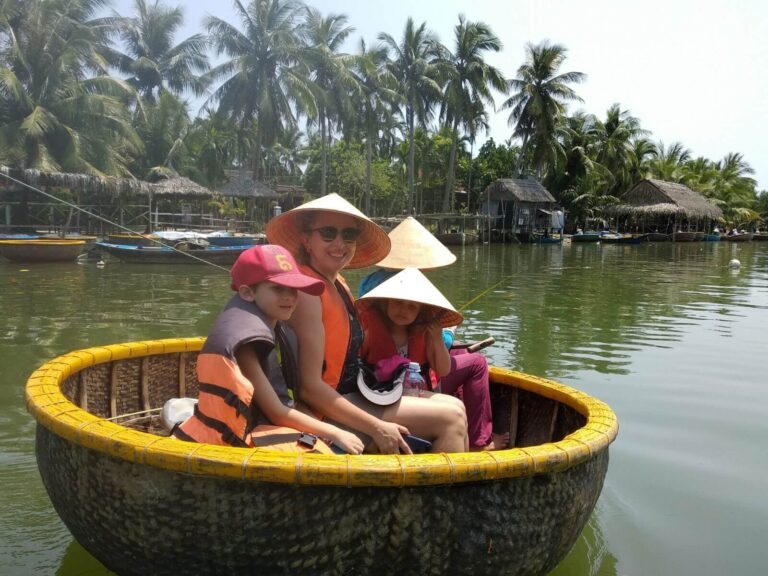
The Mekong Delta. Slowly or not at all. The day trip from the city to My Tho is a conveyor belt. A night in Can Tho for the Cai Rang floating market at six in the morning, or two nights on the small canals at Ben Tre, is a different country.
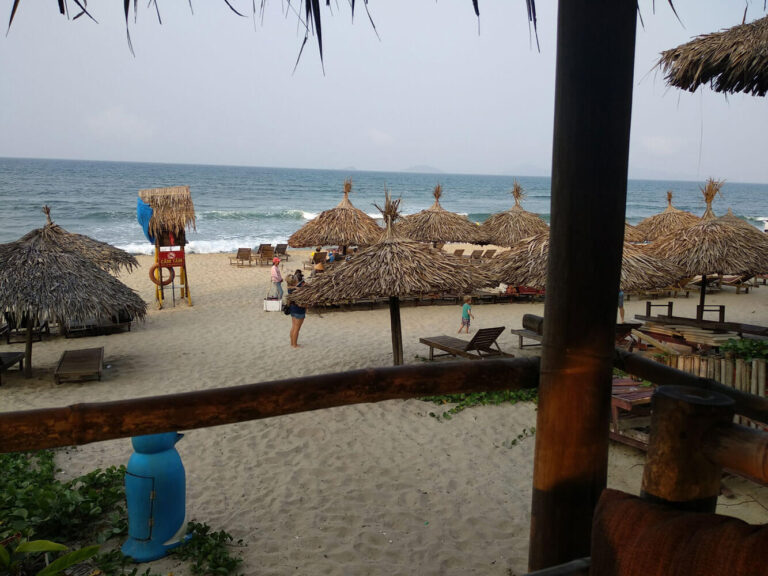
Beaches. Phu Quoc for resorts, Con Dao for quiet and history, Quy Nhon for a coast that has not been developed yet. We would steer you away from Nha Trang.
Eating in Vietnam
The food changes completely as you move down the country, which is one of the strongest arguments for doing the whole length. In the north, pho is clear and restrained, served with almost no garnish; bun cha, grilled pork in dressed broth, is Hanoi’s own; egg coffee, invented here when milk was scarce, is better than it sounds. In the centre, Hue cooks the most complex food in Vietnam, a legacy of the imperial court, and Hoi An has cao lau, a noodle made nowhere else. In the south everything is sweeter and more abundant: com tam, hu tieu, and fruit you have never seen.
Street food is where the good eating is, and the safe rule is a busy stall with high turnover and food cooked in front of you. Dietary requirements are workable but need notice, because fish sauce is in nearly everything and strict vegetarian is harder than it looks. Tell us early and our Hanoi office briefs the restaurants in Vietnamese.
Practical notes from our Hanoi office
- Money. The dong runs in large numbers, with 100,000 dong roughly $4. Cards work in cities and hotels; carry cash for markets and rural areas.
- Crossing the road. Walk out slowly, keep a constant speed, do not stop and do not run. The motorbikes flow around you. This sounds like a joke and it is the most useful thing anyone tells you in Hanoi.
- Tap water. Do not drink it. Ice in established places is fine.
- Health. No vaccinations are required for entry. Hepatitis A and typhoid are commonly recommended, and dengue, present in the cities, is a more realistic risk than malaria on most itineraries. Speak to a travel clinic before you fly.
- Heat. Plan the outdoor half of every day for before ten in the morning, and use Grab, the ride-hailing app, to move around cities without negotiating a fare.
- Language. Vietnamese is tonal and hard, and English is thin outside tourism. That is what a guide is for on the days you need one.
How we build a Vietnam trip
Every Vietnam itinerary we write is put together by one of four people: our Head of Consulting Mai, our Indochina specialist Tal, our Vietnam specialist Shira, or Noam, who lives in Hanoi and runs our office there. That office is ours, staffed year round, and covers Vietnam, Laos and Cambodia, which is why a three-country trip with us is one team rather than three suppliers.
Your $39 plan is written for you rather than pulled from a template, and if you want us to book the trip, the quote is free and carries no obligation. Two rounds of changes are included. When you travel we open a WhatsApp group with your consultant and our representatives in Vietnam, and it stays open until you are home.
Ready to plan it?
Tell us the shape of the trip you have in mind and we will build you a first outline. A plan written for you, and a free, no-obligation quote if you want us to book.
Keep reading
- The eight Vietnam itineraries we build most often
- How much does two weeks in Vietnam really cost?
- The best time to visit Vietnam, region by region
- Halong Bay: which bay, which boat
- The Vietnam e-visa, explained