This is the document our consultants work from when a new Korea file lands on the desk. It is not a list of sights. It is the set of decisions that determine whether your ten days feel like a holiday or like an exercise in guessing at bus timetables in a script you cannot read.
South Korea at a glance
| Best months | Late April to early June, late September to early November |
| Comfortable trip length | 10 to 12 days |
| Entry | Visa-free for most Western passports, plus an online travel authorisation |
| Getting around | KTX between cities, subway and taxis within them, a car only on Jeju |
| Land budget, per person per day | 160 to 620 US dollars |
| Our presence | A long-standing local partner in Seoul, not our own office |
That last line matters and we would rather write it here than bury it. GO EAST has dedicated local offices in Vietnam and India, our team in Japan, and local representatives in the Philippines. In Korea we work through a partner in Seoul we have used for years. The trips are built here, by our own specialist, and delivered there, by people we know well but do not employ.
When to travel
South Korea has four distinct seasons and a sharper temperature range than most visitors expect from a country at the latitude of southern Spain. The continental air mass to the north is the reason.
Spring, April to early June
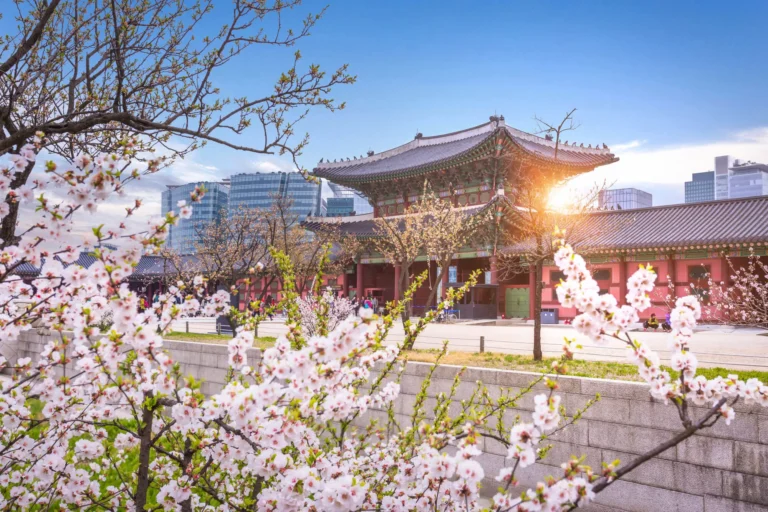
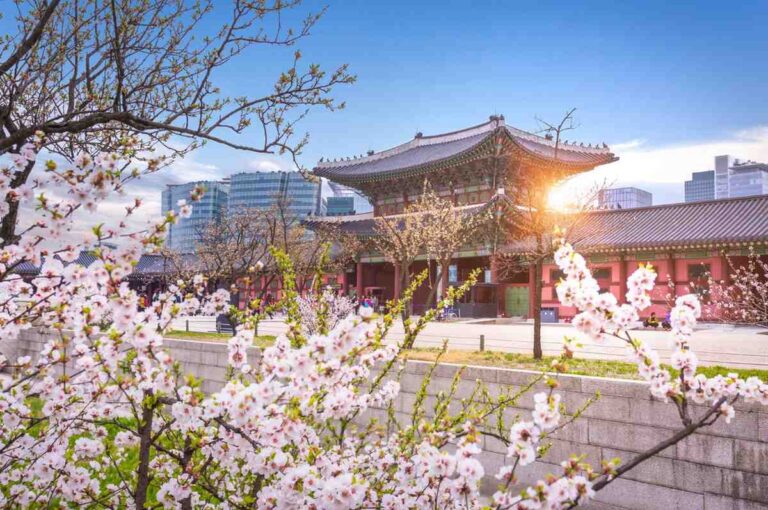
Cherry blossom reaches Jeju and the southern coast in the last week of March and Seoul around the first week of April, with dates moving year to year. It is beautiful and busy: Jinhae, near Changwon, holds the country’s biggest blossom festival and fills with domestic visitors for ten days.
Our honest preference is a few weeks later. Late April and May give warm days in the high sixties to mid seventies Fahrenheit (around 19 to 24 Celsius), clear light, azaleas, lower rates and far fewer people. Given flexibility rather than a fixed blossom date, this is the window we push you toward.
Summer, late June to August
We will not dress this up. Seoul in July and August is hot and wet. The monsoon, jangma, runs through much of July, and August brings high eighties Fahrenheit (around 30 to 32 Celsius) with humidity to match, plus the possibility of a typhoon tail into September. Walking a palace complex at two in the afternoon in August is not a good use of a holiday.
There is a real exception, which is why we do not simply say avoid summer. The mountains are at their best: Seoraksan, Jirisan and the Gangwon valleys run ten to fifteen degrees cooler than the city, and summer is when Koreans themselves head for the hills. If your dates are locked to July or August, we move the trip up and inland and cut the city time.
Jeju in summer is beautiful and extremely busy. It is Korea’s domestic holiday island, the Seoul to Jeju air route is one of the busiest in the world, and in late July and August the beaches, the coastal cafes and the Hallasan trailheads are full of Korean families. Not a reason to skip it, but a reason to go in May, June or October if you can.
Autumn, late September to early November
The best window in the Korean year, and the one we recommend when someone is free to choose. Dry, clear, and with autumn colour running the opposite way to the blossom: it starts high on Seoraksan around mid October and moves south and downhill, reaching Naejangsan and the southern parks in the first half of November.
One caution. Chuseok, the harvest holiday, falls on a lunar date in September or October. The whole country travels home, trains sell out weeks ahead, and many small restaurants close for several days. We plan around it rather than through it.
Winter, December to February
Cold. Seoul sits below freezing for much of January, with lows around 20 Fahrenheit (about minus 6 Celsius) and a dry wind off the continent that makes it feel colder. Hotel rates are the lowest of the year and the cities are at their least crowded.
It suits a particular traveller. Bathhouses and hot springs make more sense, the food does too, the palaces under snow are memorable, and Gangwon has the ski areas. It does not suit a first trip built around walking and gardens. Seollal, the Lunar New Year, causes the same closures as Chuseok.
How many days do you actually need?
This is where we disagree with most of what is written about Korea.
- 5 to 6 days. Seoul, properly, with the DMZ and one day trip. A real trip, not a compromise.
- 10 days. The complete first visit: Seoul, Gyeongju, Busan, with a day at the DMZ and time that is not scheduled. This is the answer for most people and it does not need stretching.
- 12 days. The above plus Jeju, or plus Andong and Jeonju, or a deeper run at the hiking.
- 16 to 21 days. Now Korea opens up: Jeju given a week, the southern coast and its islands, Gangwon, the tea country around Boseong, the small temple towns.
Between 10 and 16 days there is a trap. Because everything is close, it is easy to add cities that do not change the trip. Four more days spent on Daegu, Daejeon and Gwangju gives you three more mid-size Korean cities, and they are pleasant, and you will not remember them. Four days on Jeju, or on the southern islands, or across the strait in Japan, will change the trip. We will say so.
Entry requirements
Most Western passports, including the United Kingdom, the EU states, the United States, Canada and Australia, enter South Korea visa-free for a short tourist stay.
Separately from the visa question, Korea operates an electronic travel authorisation called the K-ETA, applied for online before departure. The complication is that Korea has repeatedly granted temporary K-ETA exemptions to a list of nationalities, extended them, and adjusted the list. Anything published here as a hard rule would risk being wrong by the time you read it.
So we do it the other way round. Tell us the passport you are travelling on and we confirm the current requirement in writing before you book, and send the correct link with your final documents. The same applies to the arrival declarations, which have also come and gone. If your passport is not visa-exempt, tell us early: the application is manageable but it needs lead time.
Getting around
Trains
KTX, the high-speed network, is the spine of any Korea itinerary. Seoul to Busan is about 200 miles (325 kilometres) and takes roughly two and a half hours. Gyeongju is served by Singyeongju station, around two hours from Seoul, then a short taxi into town.
The question we are asked most is whether to buy a KORAIL Pass. Usually not. Unlike Japan, where the pass maths is genuinely close, a standard Korean itinerary involves three or four legs on a network where individual tickets are inexpensive. We price your route both ways, but expect the answer to be individual tickets with reserved seats.
Where rail stops, the express buses take over, and they are better than their reputation: comfortable, frequent and cheap. They are how you reach Sokcho for Seoraksan and much of the southern coast. They are also signed and announced almost entirely in Korean, which is why we write the terminal, platform and destination in Hangul into your document.
Flights and ferries
Seoul or Busan to Jeju is a short flight and about the cheapest domestic air route you will fly anywhere. Ferries serve the southern islands and, from Busan, Japan.
Taxis and city transport
Seoul’s subway is excellent, cheap and signed in English throughout. A T-money card, bought at any convenience store, works on subways, buses and in taxis nationwide.
Taxis are plentiful and inexpensive. The catch is that the ride-hailing apps Koreans use generally need a Korean phone number to verify, so visitors mostly hail on the street or ask a hotel to call. Drivers rarely speak English. Written addresses in Hangul solve almost all of this, and they are in every document we send.
Driving
Not necessary anywhere on the standard route, and a nuisance in Seoul. Genuinely worth it in one place: Jeju, where the bus network is slow and the point of the island is the coast road. An International Driving Permit is required alongside your home licence.
One oddity worth knowing: Korean mapping data cannot be exported, so Google Maps gives poor driving navigation inside the country. Naver Map and KakaoMap are what actually work, and both have English interfaces. We tell you this before you land rather than after.
What a trip to South Korea costs
The figures below are land only, per person, based on two people sharing, and exclude international flights. They cover accommodation, food, ground transport, entries and the guiding we would normally include.
| Style | Per day | 10 days | 14 days | 21 days |
|---|---|---|---|---|
| Careful: business hotels, mostly independent | $160 | $1,600 | $2,240 | $3,360 |
| Comfortable: good 3 to 4 star, some guiding | $250 | $2,500 | $3,500 | $5,250 |
| Boutique: design hotels, private transfers | $390 | $3,900 | $5,460 | $8,190 |
| Luxury: top-tier, guided throughout | $620 | $6,200 | $8,680 | $13,020 |
Korea is cheaper than Japan at every tier, and the gap is widest at the bottom. Three things move the number more than anything else:
- Seoul hotel choice. The spread between a very good Korean business hotel and an international five-star is larger than any other single decision in the trip.
- How much guiding you take. Our default is two or three guided days out of ten. Guided throughout roughly doubles the day rate and, in a country this navigable, is rarely what we recommend.
- Jeju in high season. Island rates in late July and August are set by domestic demand and can double the May figure for the same room.
Cheaper than people expect: food and transport. A good bowl of noodles is around six dollars, a market lunch less, and the train across the country costs about the same as a taxi across Seoul in traffic.
The regions worth your time
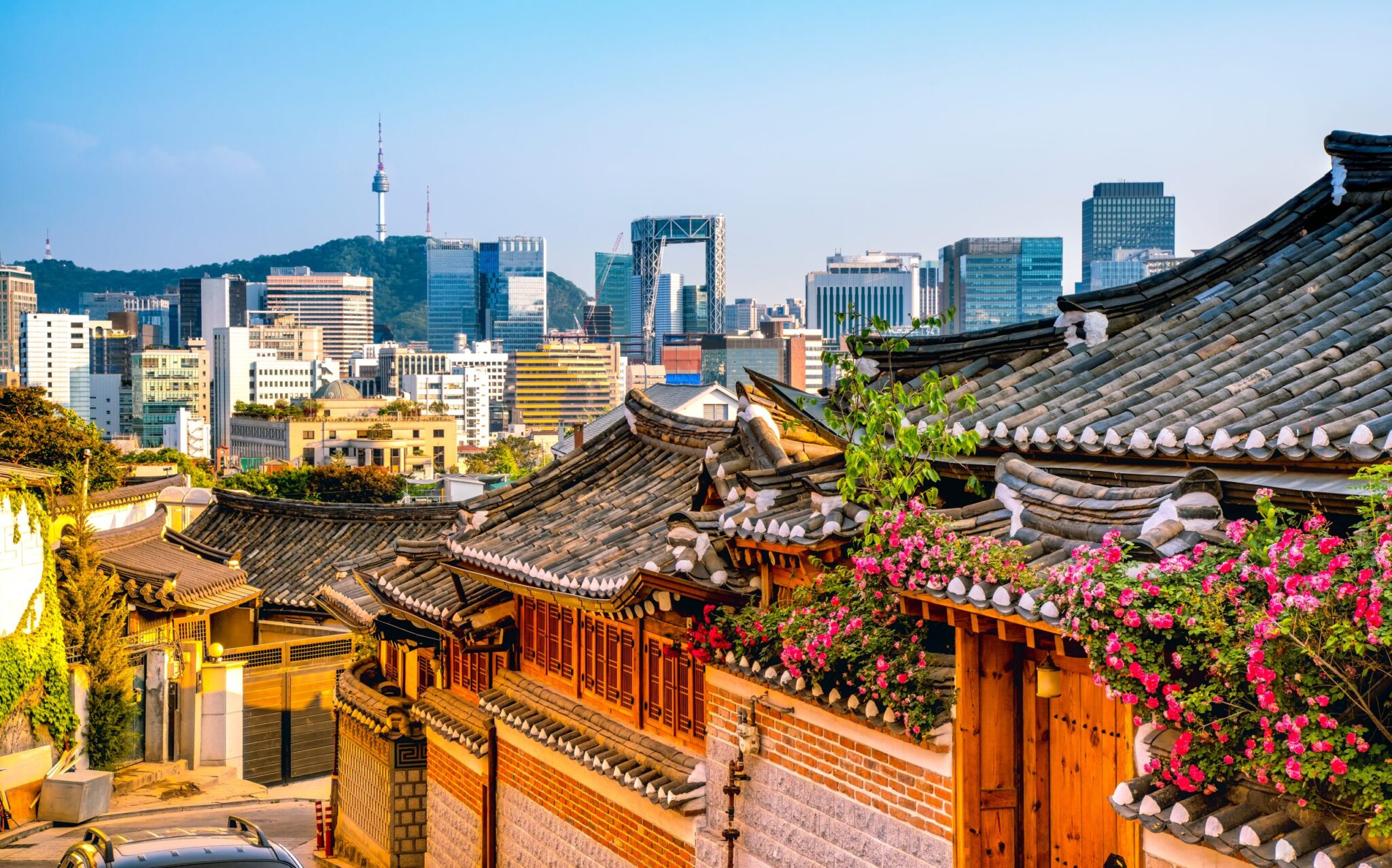
Seoul. Three to four days, planned by neighbourhood rather than by monument. The palaces, Changdeokgung’s rear garden in particular, need a timed ticket and a morning. Bukchon’s hanok lanes are a residential area that has asked visitors to keep quiet hours, and we route around the worst of it. The parts people remember are usually Seochon, Ikseon-dong, Euljiro and Seongsu.
The DMZ. Worth doing once. Understand what it is first: a coach, a fixed route to Imjingak, the Third Infiltration Tunnel and an observatory, a scripted commentary, timed stops. Joint Security Area access is a separate arrangement that has been suspended and restored more than once, so we confirm it at the time rather than promising it.
Gyeongju. The Silla capital for nearly a thousand years, and the strongest argument for leaving Seoul. Grass burial mounds in the middle of town, the Bulguksa temple complex, the Seokguram grotto above it, and a national museum that deserves two hours. Two nights.
Busan. A port city that feels like a different country to Seoul: looser, warmer, built on hills above the water. Jagalchi fish market, the painted terraces of Gamcheon, Beomeosa temple, and beaches that are genuinely used. Two to three nights.
Andong and Jeonju. The two towns carrying Korea’s traditional culture without turning it into a museum. Andong for the Hahoe folk village and the Confucian academies, Jeonju for its hanok quarter and the best food reputation in the country. One night each on a twelve-day trip.
Seoraksan and Gangwon. The best-known mountains in the country, three hours east of Seoul, spectacular in October and crowded to match. A cable car for those who want the view without the climb, and serious ridge walking for those who do not.
Jirisan and the south. Korea’s first national park and its highest mainland peak, quieter than Seoraksan, with temple stays at its feet and the Boseong tea fields and Suncheon wetlands nearby.
Jeju. A volcanic island with a distinct culture, its own dialect, the haenyeo diving women, lava tubes, a 6,388 foot (1,947 metre) volcano you can walk up, and a network of numbered coastal walking routes. It is beautiful, and it is also Korea’s domestic holiday island and very busy in summer. Go in May, June or October and it is a different place.
The southern islands. Tongyeong, Namhae, Yeosu and the islands off them. Almost no foreign visitors, ferries, seafood, and the part of Korea we most enjoy adding to a third week.
Eating well
Korean food is why a lot of people come, and the thing first visits under-plan.
Meals are shared and come with banchan, the small side dishes, refilled without charge. Many of the best restaurants are single-dish specialists: one place for pork soup, another for cold noodles, another for grilled short rib. Ordering broadly at one restaurant is usually the wrong move, and solo diners can struggle, because a lot of dishes are cooked for two minimum.
Vegetarian is harder than the vegetable-heavy menus suggest, because anchovy stock, fish sauce and shrimp paste are foundational. It is workable if planned: Korean temple cuisine is plant-based and among the best food in the country, and we brief restaurants in Korean in advance.
Markets are the best casual eating in Korea. Gwangjang in Seoul, Jagalchi in Busan, the night market at Jeonju. Go hungry, and go with someone who can read the stall signs, which on a first visit means a guide. It is one of the guided days we always recommend keeping.
The English question
We flag this because it is the most common surprise. Central Seoul is easy: signage, transport, museums and many restaurants operate comfortably in English. Move fifty miles (80 kilometres) out and it thins fast. In Gyeongju, in smaller Busan neighbourhoods, on the intercity buses and on Jeju outside the resort strip, do not assume an English menu, an English speaker at the guesthouse desk or English announcements.
None of this makes Korea hard to travel. It makes it a country where the quality of your document matters. Ours carry the Korean name of every place you are going, addresses in Hangul to show a driver, the platform and terminal names, and a translation app that works offline. That, plus guiding on the two or three days where it changes what you understand, is the solution.
How we build a Korea trip
Korea trips here are written by Masha Weiss Solomon, our in-house Korea specialist, with Mai Est, our Head of Consulting, on the harder routings and the multi-country combinations. You get a named person for the whole process, not a queue.
On the ground, we work through a local partner in Seoul we have used for many years. That is a real distinction from Japan, Vietnam, India and the Philippines, where the office and the staff are ours, and we make it rather than blur it. In practice your guides, drivers and 2am problems are handled by a company we know extremely well, briefed by us, with our consultant on the same WhatsApp thread throughout.
Your $39 plan is written for you rather than pulled from a template, and if you want us to book the trip, the quote is free and carries no obligation. Two rounds of changes are included. Our reviews all come from travellers on trips we built.
Ready to plan it?
Tell us the shape of the trip you have in mind and we will build you a first outline. A plan written for you, and a free, no-obligation quote if you want us to book.
Keep reading
- The eight Korea itineraries we build most often
- Classic Korea in 10 days
- Korea and Japan in 14 days
- How much does ten days in Korea cost?
- Is the DMZ tour worth it?