- Duration
- 11 days
- Pace
- Moderate
- Hotel changes
- 4
- Best months
- Mar, Apr, Sep, Oct, Nov
- From
- $3,740 per person
This itinerary is built around one, with eight days of the rest of the country attached. Which festival depends entirely on your dates, and that is the whole planning problem, so it is addressed in full below rather than in the small print.
Who it suits: travellers who want context rather than a checklist, and who can commit to dates early. Moderate walking, one hard day.
Your specialist: your named Bhutan specialist, with our Delhi office arranging visas, festival timing and the ground.
Which festival, and when
Tshechu dates are set by the Bhutanese lunar calendar. They move year to year against the Western calendar, sometimes by two or three weeks, and they are confirmed by the authorities relatively late. The main ones we build around:
- Punakha Drubchen and Tshechu, February or March, in the warmest valley at the coldest time of year. The Drubchen includes a re-enactment of a seventeenth century battle.
- Paro Tshechu, March or April. The largest and the most visited, ending with the unfurling of a giant appliqué thangka before dawn.
- Thimphu Tshechu, September or October. The capital’s festival, three days, enormous crowds and the best dancing.
- Jambay Lhakhang Drup, Bumthang, October or November. Older, stranger and far less visited, including a fire ceremony and a midnight dance.
- Black-Necked Crane Festival, Gangtey, 11 November. Small, fixed in date, and held in the courtyard of the monastery with schoolchildren dressed as cranes.
Tell us your window and we will tell you which of these it can reach.
Day by day
The route below is written around an autumn Thimphu Tshechu. We rebuild the order for whichever festival your dates reach.
Day 1: Fly into Paro, transfer to Thimphu. An hour’s drive to about 7,660 feet (2,335 m). Nothing else, because you have gained altitude.
Day 2: Thimphu, before the crowds. The Buddha Dordenma, the National Textile Museum, and the National Institute for Zorig Chusum, the school of the thirteen traditional arts, where students learn thangka painting, woodcarving, embroidery and clay sculpture over six years. This is the day that makes the festival legible: you will recognise what you are looking at.
Day 3: Festival, day one. Early to the dzong courtyard, because seating is first come. Your guide explains each dance as it begins, which is what turns four hours of masked movement into something you follow. Out by early afternoon, before it becomes endurance.
Day 4: Festival, day two, and the market. The second morning at the tshechu for the dances the first day does not include, then the Centenary Farmers Market if it is a weekend, and the craft bazaar.
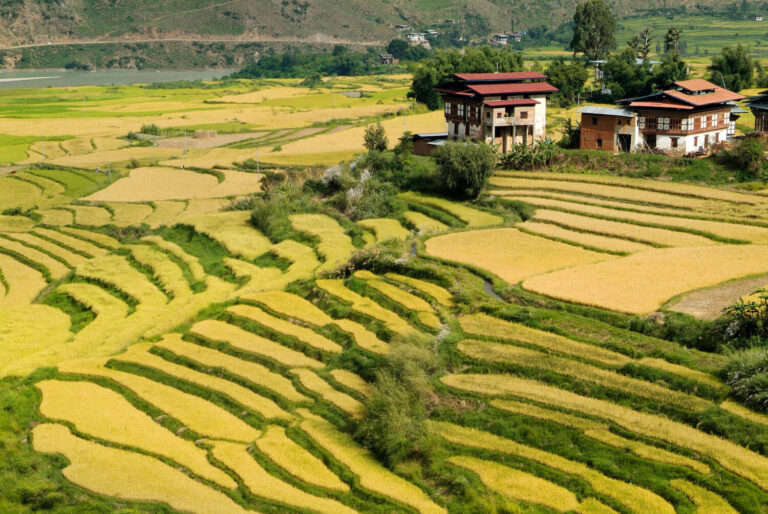
Day 5: Thimphu to Punakha. Three hours over Dochula at 10,170 feet (3,100 m), then down to about 4,300 feet (1,310 m). Chimi Lhakhang in the afternoon, reached through rice fields.
Day 6: Punakha. The dzong at the river confluence in the morning, unhurried. Afternoon: the walk up to Khamsum Yulley Namgyal Chorten, or the suspension bridge, or a village lunch with a family.
Day 7: Punakha to Phobjikha. Four hours east and up into a wide glacial valley at about 9,800 feet (3,000 m). Gangtey Goenpa, the monastery on the ridge, and the Gangtey Nature Trail, which is an easy ninety minute walk down through the valley. From late October, the black-necked cranes are here.
Day 8: Phobjikha to Paro. A long drive, five to six hours, broken with a farmhouse lunch. Afternoon in Paro.
Day 9: Paro, and the weaving. Kyichu Lhakhang, the Rinpung Dzong and the National Museum. Afternoon with a weaver, watching the backstrap loom that produces kira and gho cloth, which takes months per piece and explains why the good textiles cost what they do.
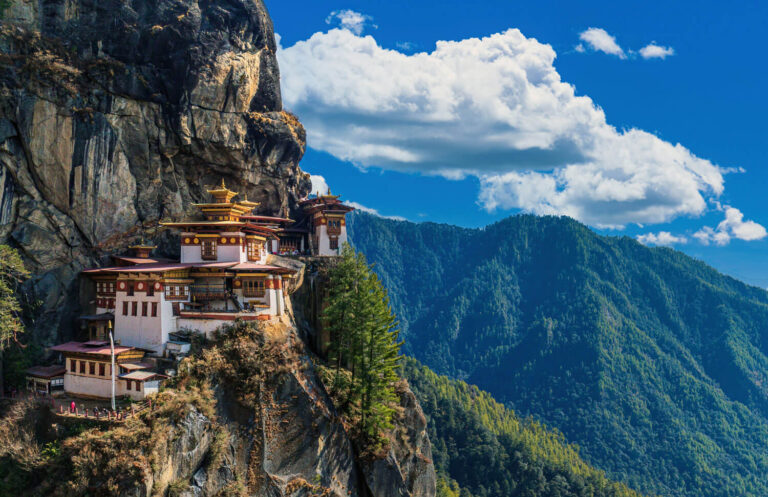
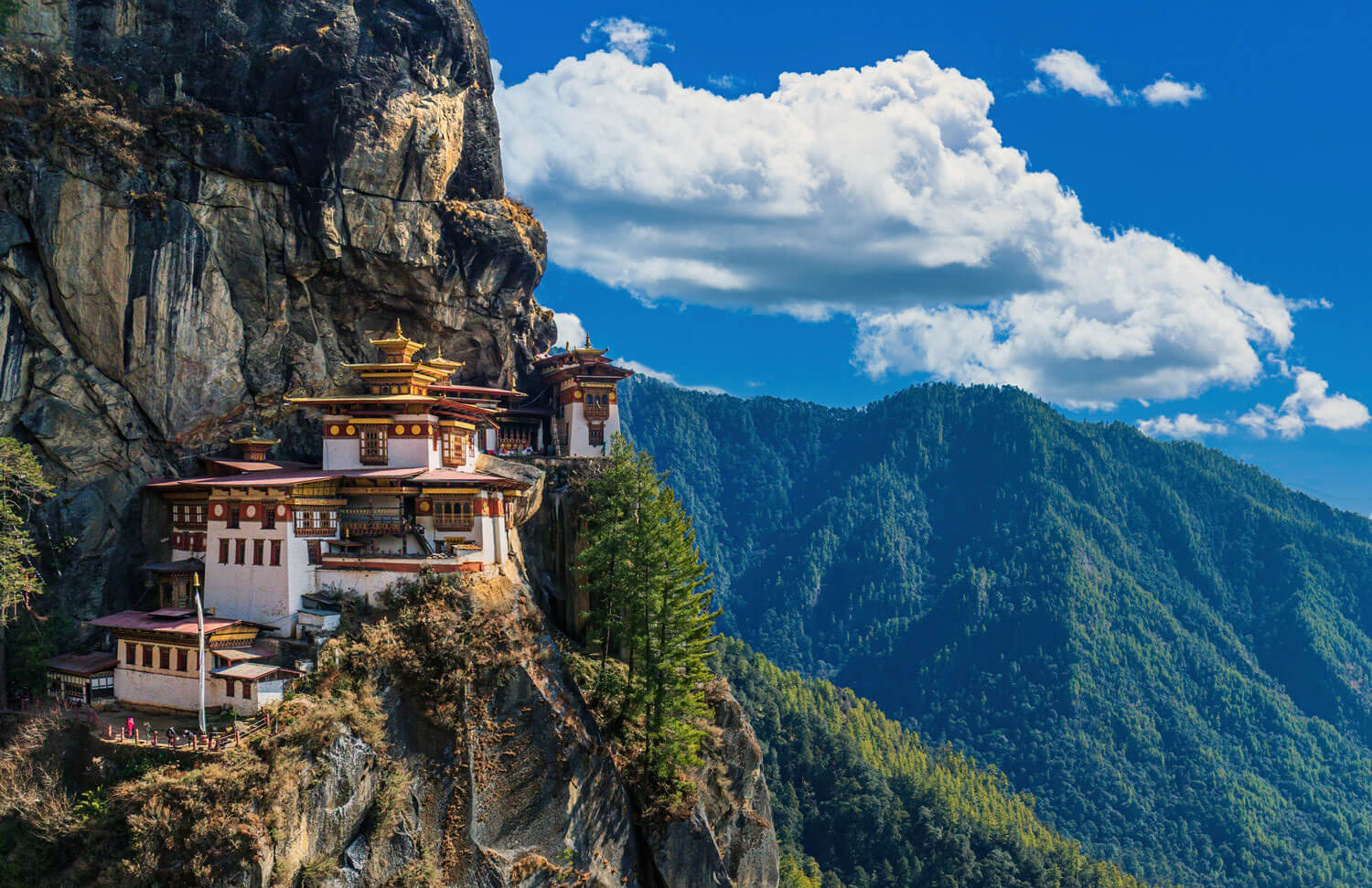
Day 10: Tiger’s Nest. Paro Taktsang at about 10,200 feet (3,120 m), roughly 1,700 feet (520 m) of steep ascent, two to three hours up. Placed here, at the end, when you are acclimatised.
Day 11: Departure. Transfer to Paro airport.
What is included
Full board throughout, private vehicle with a Bhutanese driver, a licensed English-speaking guide throughout who briefs the festival dances properly, festival seating arranged where seating exists, all entry fees, the arts school and weaving visits, a farmhouse lunch, the visa applications, the Sustainable Development Fee for all ten nights itemised per person per night, and a WhatsApp group with your specialist and our Delhi office.
What we would change, and when
- Want the least visited festival? Jambay Lhakhang Drup in Bumthang, which needs a fourteen day route or a domestic flight. The 14 day route covers Bumthang.
- Want the cranes as well? Time it to 11 November in Gangtey and we will build the rest of the trip around that fixed date, which is a rare luxury in Bhutan.
- Dates completely fixed and no festival falls in them? Say so. We build a strong cultural route without one rather than sell you a small local event as a substitute for a tshechu.
- Want fewer people? The Paro and Thimphu festivals are busy with both Bhutanese and foreign visitors. Wangdue, Trongsa and the Bumthang festivals are not.
Honest notes
Festival dates move and they are confirmed late. They are set by the Bhutanese lunar calendar, published by the government, and occasionally adjusted. A festival that fell on 12 October one year can fall on 26 September the next. If you are locking flights around a tshechu, build a day of slack either side.
Accommodation in the festival valley sells out first. The hotels in Paro and Thimphu fill for their tshechus long before the dates are formally confirmed, and the good ones fill first. Our approach is to hold rooms early on our best estimate and adjust, which is the only method that works. It means committing before you have certainty.
A tshechu is long. The dances run most of the day and each one lasts a while. Two mornings is the right amount for most people. Ten hours in a stone courtyard on a plastic chair is not.
It is a religious event, not a performance. Bhutanese families come to earn merit and to see specific dances at specific times. Photography is generally fine in the courtyard, not inside temples, and your guide will tell you where the line is. Dress properly: covered shoulders, long trousers or a skirt, and a collared shirt if you have one.
The Sustainable Development Fee applies to all ten nights and is the largest line in your quote. Festival timing does not change it.
Tiger’s Nest is genuinely steep and it is the one physically hard day here.
Built by your named Bhutan specialist, and checked by our Delhi office before it goes out.