- Duration
- 10 days
- Pace
- Moderate
- Hotel changes
- 4
- Best months
- Apr, May, Sep, Oct
- From
- $1,850 per person
The order matters. Most itineraries run west from Tashkent and then fly back from Urgench, which is what we do, because the desert crossing is a better drive than a flight and the last morning in Khiva is worth having.
Who it suits: first-time visitors, couples, and anyone whose interest is architecture, history and food. No walking beyond a city on foot in the morning.
Your specialist: a named Central Asia specialist here, with our long-standing Tashkent partner running the ground and licensed city guides in each city.
Day by day
Day 1: Arrive Tashkent. Private transfer. Most flights land at unsociable hours, which we will tell you before you book. Nothing scheduled beyond a dinner we have chosen, because Tashkent has the best restaurants in the country and it is a waste to eat at the hotel.
Day 2: Tashkent. A full day and it earns it. The metro first, which is the point of the city for anyone interested in the twentieth century: individually designed stations in marble, mosaic and pressed glass, built as public architecture. Then the Khast Imam complex, which holds the Uthman Quran, among the oldest surviving Quran manuscripts anywhere. Chorsu bazaar under its blue dome for lunch and for the bread. Afternoon in the Soviet modernist city and the applied arts museum.
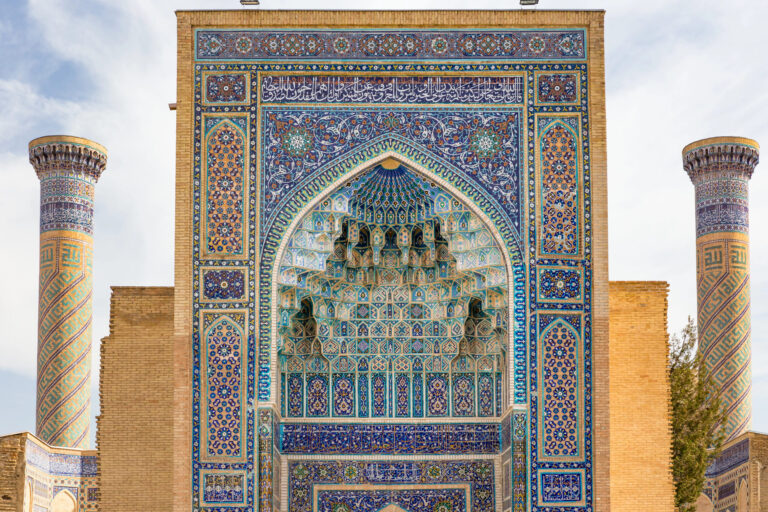
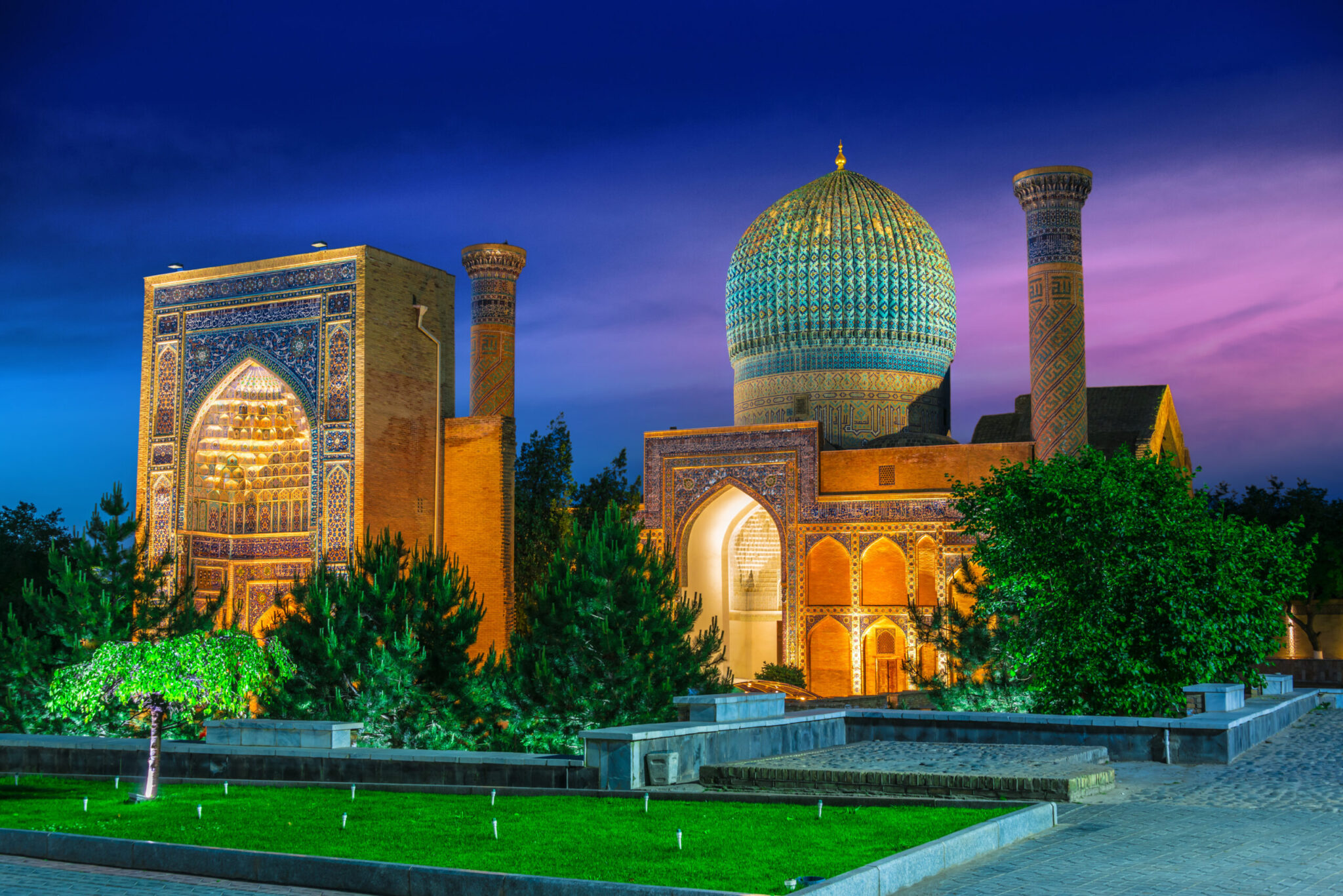
Day 3: Train to Samarkand. The Afrosiyob, a little over two hours, arriving mid morning. Straight into Gur-e-Amir, where Timur is buried under a slab of dark jade, and which is the best introduction to what the whole trip is about. Afternoon free. Evening at the Registan when it is lit.
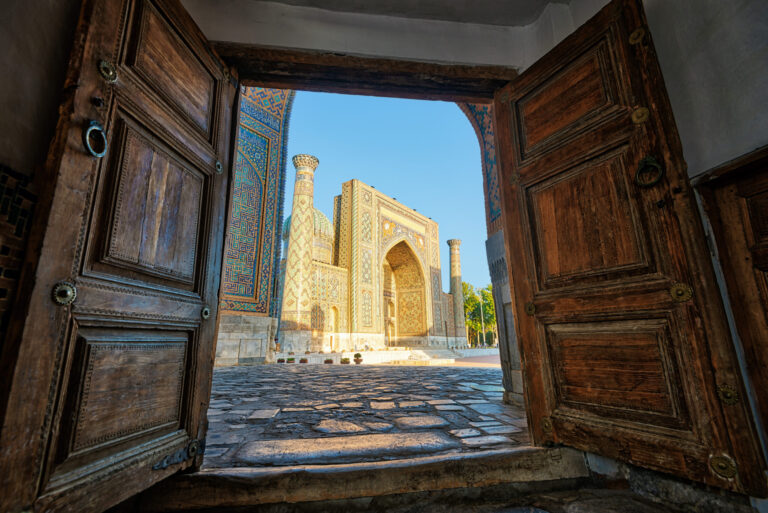
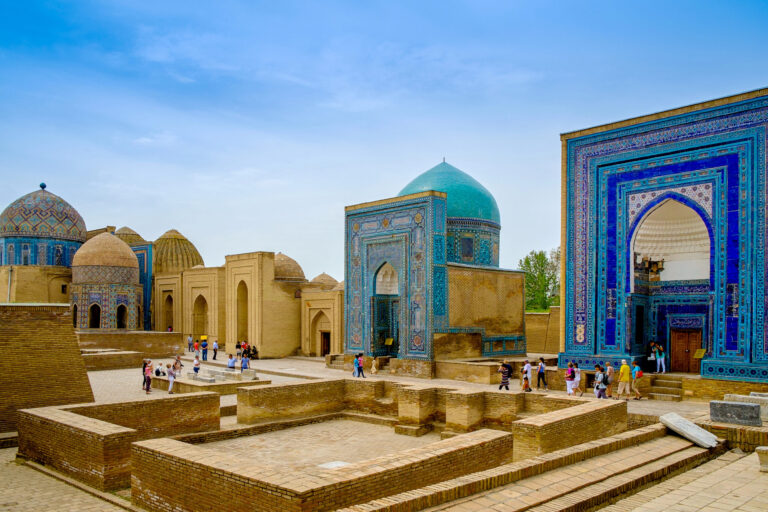
Day 4: Samarkand. Shah-i-Zinda at eight in the morning, before anyone else, which is a lane of tiled mausolea climbing a hillside and the most beautiful thing in the city. Then the Registan properly, with time inside all three madrasas. Bibi-Khanym mosque, which is enormous and which was largely reconstructed from the 1970s, a fact your guide will point out as you walk in. Siab bazaar next door for the bread and the dried fruit.
Day 5: Samarkand, and the train to Bukhara. Morning at Ulugh Beg’s observatory, where the underground arc of the great sextant is original fifteenth-century work and everything above ground is not, and the Afrasiab museum. Or a paper workshop at Konigil, where mulberry paper is made by the old method. Afternoon train to Bukhara, about an hour and a half.
Days 6 to 8: Bukhara. Three nights, which is the recommendation we make most often and the one most people are glad of.
Day six: the Poi Kalyan ensemble, the minaret of 1127 that Genghis Khan is said to have left standing, the mosque and the Mir-i-Arab madrasa opposite, which is a working madrasa and not open inside. The Ark fortress. The trading domes and the covered bazaars between them.
Day seven: the Samanid mausoleum, tenth century, unrestored fired brick and the oldest important building in the country, which after two days of tile is a lesson in what came first. Chashma-Ayub, Bolo Hauz mosque with its wooden columns, and the afternoon at the Sitorai Mokhi-Khosa summer palace outside town, which is a strange and enjoyable collision of Russian and Bukharan taste.
Day eight: free. Options in your document: the Chor Bakr necropolis, a suzani workshop, a hammam, the Jewish quarter and its cemetery, or three hours in a chaikhana by Lyabi-Hauz doing nothing at all.
Day 9: Bukhara to Khiva. The desert. About six hours west across the Kyzylkum, flat and empty, with a stop at the Amu Darya, the river that used to reach the Aral Sea. Arrive Khiva in the late afternoon, which is the right time: the walled city of Ichan Kala at dusk, when the day groups have gone and the brick goes orange, is the reason to stay inside the walls.
Day 10: Khiva, and out. Morning in Ichan Kala with a guide: the Kalta Minor, the fat turquoise minaret that was never finished, the Juma mosque with its forest of carved wooden columns, the Tosh Hovli palace and the climb up the Islam Khoja minaret. Then the short transfer to Urgench and the flight to Tashkent, connecting to your international departure, or a night in Tashkent if the timing is poor.
What is included
Accommodation with breakfast throughout, all Afrosiyob train seats in business class booked the day the window opens, the Urgench to Tashkent flight, a private car with driver for the desert crossing and all transfers, licensed English-speaking city guides in Tashkent, Samarkand, Bukhara and Khiva, all site entries including the Ichan Kala combined ticket, a written note on what is original and what was restored at each site, restaurant reservations, and a WhatsApp group with your consultant and our Tashkent partner team throughout.
What we would change, and when
- Have two more days? Add the Nuratau mountains and a night in a yurt camp by Lake Aydarkul between Samarkand and Bukhara. It is the best break in an otherwise urban route.
- Interested in craft? Add the Fergana valley at the start, which is Rishtan ceramics and Margilan silk, and turns ten days into thirteen. That is our craft route.
- Only eight days? Drop Khiva rather than compressing everything. Khiva done badly is worse than Khiva not done.
- Travelling in summer? We restructure the days entirely: out at six, back by eleven, out again at five. Same sites, fewer of them, and we would rather move your dates.
Honest notes
Book early, for the trains. Afrosiyob seats between Tashkent, Samarkand and Bukhara sell out in April, May, September and October. Tickets are released a set number of weeks ahead and we book yours the day they open. This is the single most common way an Uzbekistan trip goes wrong.
A great deal of what you will photograph is restoration. The Registan facades were re-tiled and the leaning minarets structurally corrected in the Soviet period. Bibi-Khanym was largely rebuilt. Much of Khiva was restored from the 1970s and a large share of its buildings are now display space with relatively few residents inside the walls. We think all of it is worth seeing and we will tell you which is which as you stand in front of it, because knowing changes what you look at.
The heat is real. June to August passes 100°F (38°C) in Bukhara and Khiva regularly. There is no shade in Ichan Kala. April, May, September and October are the windows and we will push you towards them.
The desert drive is six hours and it is flat. Some people find it meditative and some find it long. The alternative is a slow overnight train, which we would not choose.
Bukhara is where you will want the extra night, not Samarkand. Samarkand has the greater monuments. Bukhara is the better city to be in.
Built by your named Central Asia specialist, checked by our Tashkent partner team before it goes out.