The best time to visit South Korea is mid-September to early November, with late April to early June a close second. October is the clearest, driest month in Seoul, with daytime highs around 21C (70F), and it is also the month that books out first. Spring brings blossom in early April and warm, green weeks in May. July and August are hot and wet in the cities, and December to February are cold and dry. Korea has four genuinely distinct seasons and a sharper temperature range than people expect from a country at the latitude of southern Spain, because the continental air mass to the north drags winters down with dry Siberian wind and pushes summers up with monsoon air from the south.
Who this is for: first-time and returning visitors planning 10 to 14 days in Korea who can still choose their dates, and anyone whose dates are fixed and wants to know what to change.
Updated October 2026 · Masha Weiss, South Korea travel consultant, Go East Travel
What is the weather in Seoul month by month?
Long-term averages for Seoul, rounded. Current forecasts and the official climate normals are published by the Korea Meteorological Administration (checked October 2026); we use them to confirm your dates before quoting.
| Month | Seoul, average high | Character | Our verdict |
|---|---|---|---|
| January | 34F (1C) | Cold, dry, clear, empty | Good value, wrong for a first visit |
| February | 39F (4C) | Still cold, Seollal closures | The weakest month |
| March | 50F (10C) | Erratic. Blossom reaches the south late in the month | Improving, unreliable |
| April | 62F (17C) | Blossom in Seoul early, then green. Busy | Very good, book early |
| May | 73F (23C) | Warm, clear, azaleas, low rain | Our favourite month |
| June | 80F (27C) | Hot, humid, rains arrive late in the month | Good until roughly the 20th |
| July | 84F (29C) | Jangma, the rainy season | Avoid in the cities |
| August | 87F (31C) | Hot, humid, domestic holiday peak | Avoid, or go to the mountains |
| September | 81F (27C) | Improves sharply after the first fortnight | Good from mid-month |
| October | 70F (21C) | The best month in the Korean year | Excellent, book six months out |
| November | 55F (13C) | Colour finishing in the south, cold arriving | Very good in the first half |
| December | 40F (4C) | Cold, dry, bright, cheap | Good for a specific traveller |
When is spring in Korea, and is cherry blossom worth planning around?
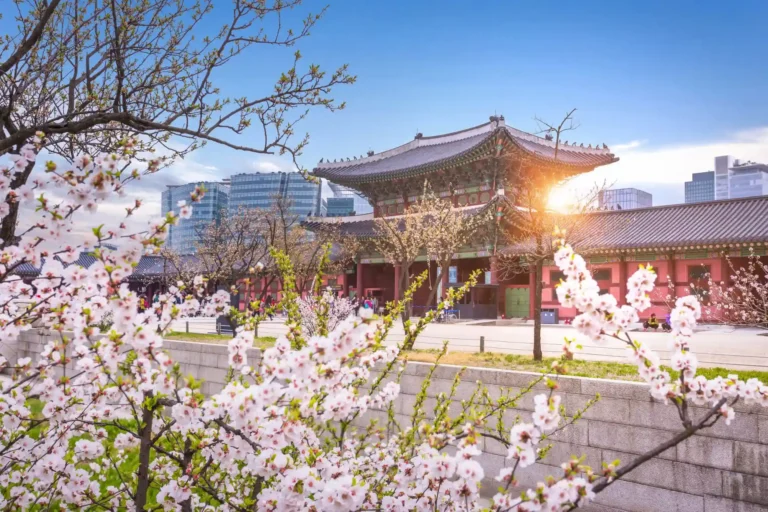
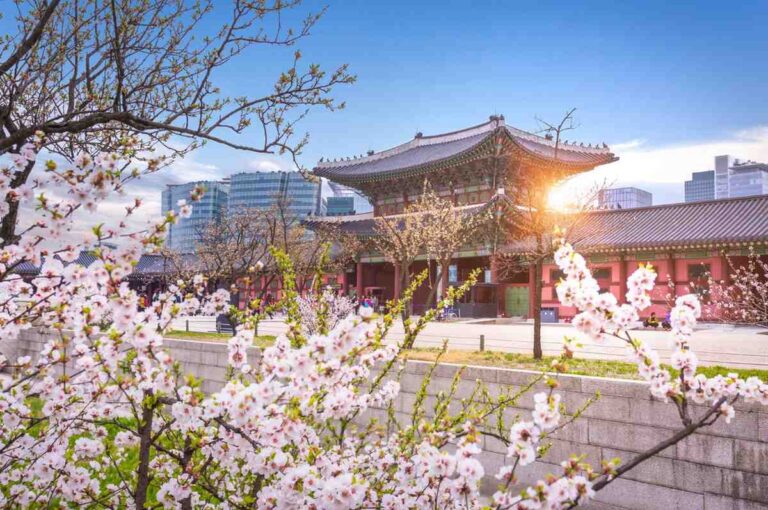
Spring runs from late March to early June, and the blossom is lovely, crowded and impossible to promise six months ahead. Blossom reaches Jeju and the southern coast around the last week of March and Seoul in the first week of April, with dates moving year to year by a week in either direction. We give the forecast as guidance and confirm the current projection when your dates are set, because nobody can promise a blossom date six months ahead and anyone who does is selling something.
Jinhae, near Changwon, holds the country’s largest blossom festival and fills with domestic visitors for about ten days. It is genuinely lovely and it is genuinely full. If blossom is the reason for the trip, go, and accept the crowds as part of the deal.
Our own preference is a few weeks later, and we say so even though it costs us the blossom-week bookings. Late April and May give warm days in the high sixties to mid seventies Fahrenheit (around 19 to 24 Celsius), clean light, azaleas on the hillsides, lower hotel rates and far fewer people. Given flexibility rather than a fixed date, this is the window we push you toward.
Why is May the underrated month?
May is the month we would choose for a first trip if autumn were not available. It is warm without being humid, the mountain trails are dry, Jeju is at its best before the domestic season starts, and the country is green in a way that photographs badly and feels wonderful.
Buddha’s birthday falls in April or May on a lunar date and the temples hang lanterns for weeks around it. It is the best time to see a working Korean temple, and one of the reasons the food and culture route often lands in May.
Should you visit Korea in summer?
Not for a city trip. Seoul in July and August is hot and wet, and we will not dress this up.
The jangma, the East Asian rainy season, runs through much of July. It is not a shower pattern, it is days of heavy rain interspersed with days of thick humidity. August brings highs in the high eighties Fahrenheit (around 30 to 32 Celsius) with humidity to match, plus the possibility of a typhoon tail into September. Walking a palace complex at two in the afternoon in August is not a good use of a holiday, and we will tell you that before you book rather than after.
There is a real exception, which is why we do not simply say avoid summer.
The mountains are at their best. Seoraksan, Jirisan and the Gangwon valleys run ten to fifteen degrees Fahrenheit cooler than the city, the forest is dense and green, the streams are full, and summer is when Koreans themselves head for the hills. If your dates are locked to July or August, we move the trip up and inland and cut the city time. Hiking Korea in 12 days is a summer-workable trip in a way that a palace-and-market itinerary is not.
Jeju in summer is beautiful and extremely busy. The Seoul to Jeju air route is one of the busiest in the world, and in late July and August the beaches, the coastal cafes and the Hallasan trailheads are full of Korean families. Not a reason to skip Jeju, a reason to go in May, June or October.
Room rates follow the same pattern. August island pricing is set by domestic demand and can be nearly double the May figure for the same room, which is covered in what ten days in South Korea costs.
Why is autumn the best time to visit Korea?
Because mid-September to early November gives the cleanest air, the clearest light and the autumn colour, all at walking temperatures. It is the window we recommend whenever someone is free to choose.
Air quality is at its annual best, the humidity breaks in the first half of September, and the light through October is the clearest you will see. Temperatures sit in the sixties and low seventies Fahrenheit (around 16 to 23 Celsius) through most of October, which is exactly right for a country you see on foot.
Autumn colour runs the opposite way to the blossom. It starts high on Seoraksan around the middle of October, comes down the mountain over about ten days, and moves south, reaching Naejangsan and the southern parks in the first half of November. If colour is the point of the trip, the route should move south as the month goes on rather than north. We plan that deliberately, and the timing is discussed in hiking Seoraksan.
Two cautions.
Chuseok, the harvest holiday, falls on a lunar date in September or October. The whole country travels home, KTX seats sell out weeks ahead, many small restaurants close for several days and the roads out of Seoul stop working. In 2027 Chuseok falls on 15 September, with the public holiday running 14 to 16 September. We plan around it rather than through it, and we confirm the dates against the official calendar before quoting.
October books out. For the second half of October, six months of lead time is realistic, and the constraint is usually not flights or big hotels but the small hanok stays in Gyeongju and Jeonju, which have four or six rooms and fill first.
Is winter in Korea worth it?
For a returning visitor or someone who likes cities in the cold, yes. For a first trip built around walking and gardens, no.
Seoul sits below freezing for much of January, with lows around 20 Fahrenheit (about minus 6 Celsius) and a dry wind off the continent that makes it feel considerably colder. Snow falls but rarely lies long in the city.
What winter buys you is the lowest hotel rates of the year, the emptiest sites, and a version of Korea that makes more sense than the summer one. The bathhouse culture, the hot spring towns, the stews and the grilled meat and the barley tea all read as winter food because they are winter food. Palaces under snow are memorable. Gangwon has the ski areas, an hour or two from Seoul on the KTX line built for the 2018 Winter Olympics.
What it does not suit is a first trip built around walking, gardens and long days outdoors. Daylight is short, and standing in a courtyard listening to a guide at minus five is a test of enthusiasm.
Seollal, the Lunar New Year, falls in January or February and causes the same closures and travel chaos as Chuseok. In 2027 it falls on 6 February, with the holiday running 6 to 8 February. February is the month we would choose last.
Which months are best for each region?
The country is not uniform: Busan and Jeju are milder than Seoul, and the mountains peak two weeks before the cities.
| Region | Best months | Worth knowing |
|---|---|---|
| Seoul and the north | Late Apr to early Jun, late Sep to early Nov | Coldest winters, worst summer humidity, and the winter air quality dips |
| Gyeongju and the southeast | Apr, May, Oct | Milder than Seoul year round, and beautiful in the first fortnight of April |
| Busan and the south coast | May, Jun, Sep, Oct | The warmest mainland corner. Swimmable from late June, typhoon-exposed in September |
| Seoraksan and Gangwon | Jun to Sep for walking, mid-Oct for colour | Colour peaks about two weeks before Seoul. Trails are packed at that peak |
| Jirisan and the southwest | May, Oct, early Nov | Quieter than Seoraksan and colour arrives later |
| Jeju | May, Jun, Oct | Milder in winter than the mainland, and windy. August is domestic peak |
So which month would we book?
If someone gave us free choice and one trip: the second week of October, moving south through the month. Clear air, autumn colour beginning at Seoraksan, warm afternoons, cold enough at night for the food to make sense.
Second choice: mid-May. Almost as good, meaningfully cheaper, and much easier to book late.
The month we would refuse to build a city trip in is July. Not because it rains, but because it rains in a way that removes the outdoor half of Korea. If those are your only dates, we build you a mountain trip and say so in writing, which is the approach set out in South Korea in ten days and in what we would skip.
Plan this trip
Tell us your dates and the places you want to see, and we build your trip as a $39 day-by-day plan, with recommended hotels by level and every transfer set out step by step.
Keep reading
- Custom South Korea trips
- South Korea: the complete guide to planning your trip
- What does ten days in South Korea cost?
- Hiking Seoraksan, and how Koreans actually hike
- Classic Korea in 10 days
- Hiking Korea in 12 days
- Korea and Japan in one trip