Here is the route we build most often, argued rather than listed, with the alternatives named and the reasons we did not choose them.
Everything below assumes the season, which is roughly June to September. Outside it the passes are shut, the camps are down and this route does not exist. That is covered in Kyrgyzstan month by month.
The principle: one direction, gaining height
Two rules shape every good Kyrgyz itinerary.
Go round in one direction. The country is a set of valleys reached one at a time from a road network shaped like a ring in the north with spurs off it. Doubling back costs six hours, every time.
Gain height gradually. Song-Kul is at about 10,000 feet (3,000 m) and Tash Rabat at about 10,500 feet (3,200 m). Arriving at either on day two from a city at sea level produces a headache, a bad night and a wasted day. Sleeping at Bishkek’s 2,600 feet (800 m), then the lake at 5,300 feet (1,600 m), then Naryn at around 6,600 feet (2,000 m) and only then going high costs nothing if the order is right.
The route below does both.
The route, day by day
Days 1 and 2, Bishkek
Fly in overnight, which most people do, and sleep. Bishkek is a Soviet-planned grid of wide avenues under heavy tree cover, with the best food in the country, a serious bazaar at Osh Market and a set of squares and statues that tell you a good deal about how the country sees itself.
Nobody comes to Kyrgyzstan for Bishkek and almost everybody enjoys it. Two nights, one of them jet lag.
Half a day at Ala Archa national park, forty minutes from the city at 6,600 feet (2,000 m), is the right first walk: a glacial valley with a path up it, thin air without consequence, and a useful gauge of how your legs feel at altitude.
Day 3, Bishkek to Issyk-Kul south shore, via Burana
Four to five hours with stops. Burana Tower, an eleventh-century minaret on the site of Balasagun with a field of balbal, carved stone grave markers, is a proper half-hour stop and the clearest link to the country’s urban Silk Road past.
Then east and along the south shore rather than the north, which is the first opinionated choice in this route and one we defend in Karakol and the Issyk-Kul shore. In July and August the north shore is a domestic beach resort and the south is quiet.
Day 4, the south shore
Skazka canyon, red and eroded and small enough to walk in an hour. The petroglyph field at Cholpon-Ata is on the other side, and we skip it. Swim in the lake, which is around 68°F (20°C) in August and slightly saline, and which never freezes.
Days 5 to 7, Karakol
The most useful base in the country, and three nights rather than two.
A wooden Orthodox cathedral built without nails, a Dungan mosque that looks like a Chinese temple, ashlan-fu at the market for two dollars, and if your dates allow it, the Sunday animal market, which starts before dawn and is the least staged thing in Kyrgyzstan.
Out of Karakol: Jeti-Oguz, the red rock formation with a valley behind it. Altyn Arashan, hot springs up a track that takes two hours to cover ten miles (16 km), which is the point rather than a complaint. And the Ala-Kul trek, which is a serious two or three days over a 12,500 foot (3,800 m) pass for people who came to walk.
Three nights lets you do two of those three and still eat properly.
Day 8, Karakol to Naryn
Six to seven hours, south over the lake’s eastern end and up onto the plateau. A long day and a beautiful one, through country that empties as you climb.
Naryn is a single-street town in a gorge at about 6,600 feet (2,000 m). Nobody would call it charming and it is exactly the right place to sleep the night before you go high.
Days 9 and 10, Tash Rabat
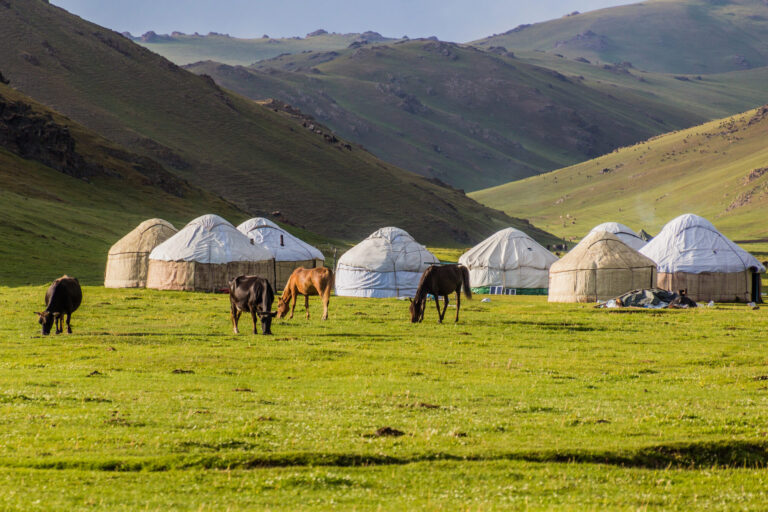
Two and a half hours from Naryn, the last of it on a rough valley track. Tash Rabat is a stone caravanserai of thirty-odd domed rooms at about 10,500 feet (3,200 m), probably fifteenth century, and the only substantial stone building on the Kyrgyz Silk Road. You sleep in yurts beside it.
Two nights, because the second day is what makes it: a walk or ride up to the Chatyr-Kul overlook at around 12,000 feet (3,650 m) with the Chinese border beyond it, and an afternoon in a valley with nothing in it.
This is where a permit matters if you want to go further to Kel-Suu, and permits take days rather than hours.
Days 11 and 12, Song-Kul
Five to six hours from Tash Rabat via Naryn and the Kalmak-Ashuu pass at around 11,300 feet (3,450 m), the last two hours on gravel switchbacks.
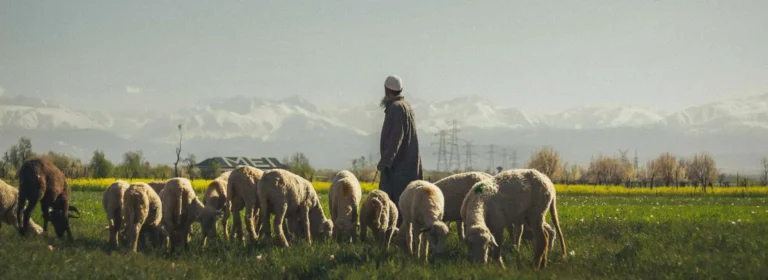
Song-Kul is a lake at about 10,000 feet (3,000 m) ringed by summer pasture, with no permanent building on it. Horses, sheep, yurts, no phone signal and a night sky that is the whole reason to stay two nights rather than one.
Two nights, always. One night here is seven hours of driving, a meal, a poor night’s sleep at altitude and a departure. Two gives you a full day on the pasture, a ride out with a horseman, an afternoon doing nothing and a second night when you have acclimatised enough to sleep. The honest description of what those nights involve is in Song-Kul and horse trekking.
Day 13, Song-Kul to Bishkek via Kochkor
Six hours down off the pass, with a stop in Kochkor for shyrdak felt carpets made by a women’s cooperative, which is where you should buy them rather than in a Bishkek shop.
A hot shower in Bishkek on day 13, after two nights on a jailoo, is one of the more memorable showers of anybody’s life.
Day 14, Bishkek and out
Osh Market in the morning, a good lunch, and the flight.
Why not the other four routes
The northern loop repeated at leisure. Ten days of this route without Naryn and Tash Rabat, stretched to fourteen with extra nights on the lake. Perfectly pleasant, and it wastes the four days that make Kyrgyzstan unusual. This is the ten-day classic and it should stay ten days.
North and south, with a flight to Osh. Ten days in the north, then fly to Osh and spend four days on Sulaiman-Too, in Arslanbob’s walnut forest and in the Alay valley under the north face of Peak Lenin at 23,406 feet (7,134 m). This is a genuinely excellent alternative and we build it often. We do not make it the default because the south is a different country in feel, hotter and more Uzbek, and two weeks split across both halves gives you less of each. If you already know you want the south, take this one.
Kel-Suu instead of Song-Kul. A long lake below cliffs in the border zone, on a rough track, needing a permit and a good deal of luck with weather. It is more dramatic than Song-Kul and less reliable. We put it in the fourteen-day Tash Rabat and southern mountains route for travellers who want the harder version, and we do not make it a first-visit default.
Kyrgyzstan and Uzbekistan in fourteen days. The most common request and the one we push back on hardest. Seven days in each gives you Bishkek, the lake and a rushed Song-Kul against Tashkent, Samarkand and a rushed Bukhara, and neither country gets what it needs. The combination is a twenty-one day trip, and it is exactly what we build.
The horse-riding variant
If you ride, the route changes shape: fewer bases and a supported multi-day trek across the pastures with pack animals and a cook. That is a different holiday from fourteen days in a vehicle with rides attached, and a better one for the right traveller. The honest detail is in Song-Kul and horse trekking.
Drive hours in this route
The whole point of the ordering above is to keep the vehicle days honest. Here is what you are actually signing up for:
| Day | Leg | Hours |
|---|---|---|
| 3 | Bishkek to south shore, via Burana | 4 to 5 |
| 5 | South shore to Karakol | 2 |
| 8 | Karakol to Naryn | 6 to 7 |
| 9 | Naryn to Tash Rabat | 2.5 |
| 11 | Tash Rabat to Song-Kul | 5 to 6 |
| 13 | Song-Kul to Bishkek, via Kochkor | 6 |
Six driving days out of fourteen, two of them long. That is a moderate pace for this country, and it is only achievable because the route runs in one direction. The comparison across lengths is in how many days do you need in Kyrgyzstan.
Plan this trip
Tell us your dates and the places you want to see, and we build your trip as a $39 day-by-day plan, with recommended hotels by level and every transfer set out step by step.
Keep reading
- Kyrgyzstan: the complete guide to planning your trip
- Tash Rabat and the southern mountains, 14 days
- Song-Kul and horse trekking, honestly
- Karakol and the Issyk-Kul shore
- How many days do you need in Kyrgyzstan?
- All our Kyrgyzstan trips