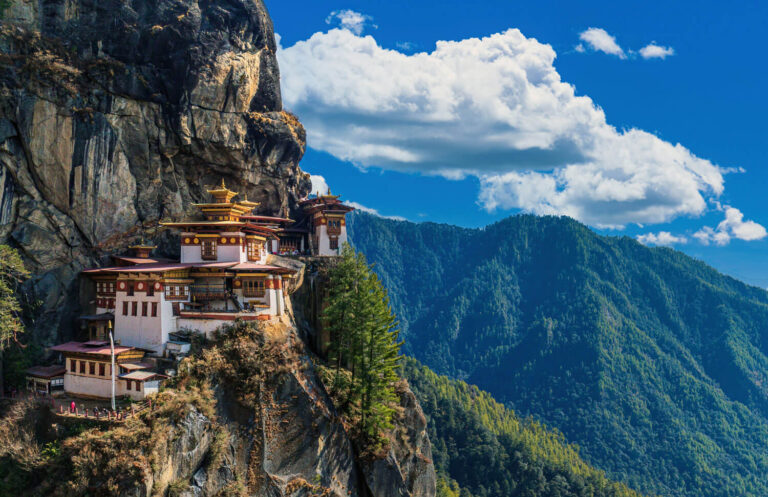
Paro and Thimphu are where you land and where the government is. They are not where Bhutan is most itself. That happens once you cross the pass at 10,170 feet (3,100 m) and drop into the warm river valleys, and it keeps happening the further east you go, until at Bumthang you are in a part of the country that most visitors never see.
This is a guide to those valleys, what is in each one, and how many nights each genuinely earns.
Punakha, and why one night is a mistake
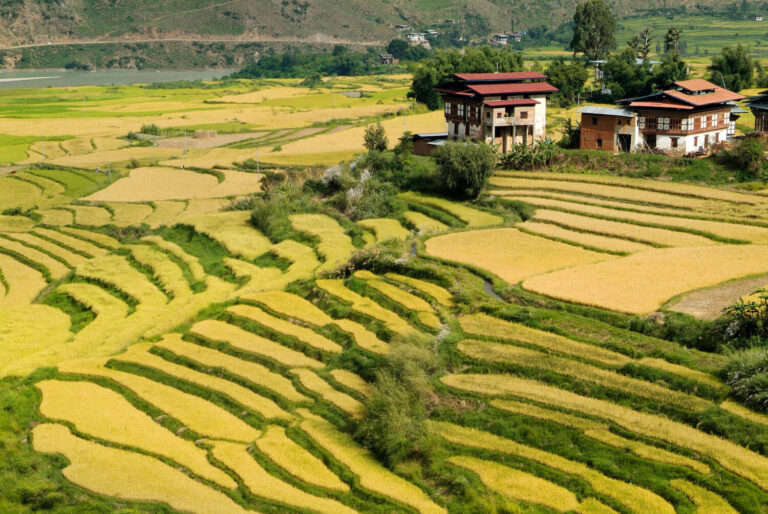
Punakha sits at about 4,300 feet (1,310 m) at the confluence of two rivers, the Pho Chhu and the Mo Chhu. It is roughly fifteen degrees warmer than Thimphu, it is green, it grows rice on terraces, and it looks like a different country from the one you drove out of three hours earlier.
Almost every operator gives it one night. That is enough to see the dzong and to have driven a long way, and it is not enough to have been anywhere.
Punakha Dzong is the finest building in Bhutan and it is not a close contest. It stands on the spit where the two rivers meet, with a cantilever bridge, a whitewashed mass of walls that reads as a fortress from below, and courtyards inside that are calmer than the exterior suggests. It was the country’s administrative capital until the 1950s and it is still where the coronations happen. Give it two unhurried hours in the morning rather than forty minutes on the way somewhere. In April and May the jacaranda along its walls is out.
Chimi Lhakhang is a twenty minute walk through rice fields to a small temple associated with a fifteenth century teacher known for methods that make guidebook writers nervous. The walk is the point: field paths, farmhouses, children, and phallus paintings on the walls of half the buildings, which your guide will explain properly and which are neither a joke nor a tourist invention.
Khamsum Yulley Namgyal Chorten is an hour’s climb up through terraces on the other side of the river, with a view back down the valley that is the best in western Bhutan. Steep enough to be a real walk, short enough to do before lunch.
The suspension bridge is about 590 feet (180 m) of steel and prayer flags across the Pho Chhu. Adults photograph it. Children run across it.
The Mo Chhu float is a gentle ninety minute raft down the river past the dzong, which is a genuinely good way to see the building from the water and involves almost no whitewater.
A farmhouse day is the thing we would insist on. A morning walk between villages on the valley floor, lunch in a kitchen where everybody sits, and an afternoon that is yours. If you want a hot stone bath, this is the night: river stones heated in a fire and dropped into a wooden trough of water and artemisia leaves. It is a genuinely good thing rather than a spa treatment.
How many nights: two minimum, three if you have fourteen days. It is also where Bhutan’s best value in comfort terms sits, because the river lodges here are good and the valley is warm enough to sit outside in.
Phobjikha and Gangtey
Four hours east and up from Punakha, into a wide, flat-bottomed glacial valley at about 9,800 feet (3,000 m). It is the quietest place on the standard circuit and the one people are most surprised by.
Gangtey Goenpa sits on a ridge above the valley floor, a seventeenth century monastery with a working monastic school. The Gangtey Nature Trail runs down off the ridge and along the valley for about ninety minutes on the flat, which is the easiest good walk in Bhutan and the one to do at the end of the afternoon.
The black-necked cranes arrive from late October and stay through the winter, several hundred of them, in a valley that has organised itself around not disturbing them: no overhead power lines, controlled development, and a monitoring centre that will show you where the birds are. The crane festival at the monastery is held on 11 November, which is one of very few Bhutanese dates that does not move.
Cold at night, always. The valley is high and open and the hotels here range from simple to two of the best lodges in the country.
How many nights: one on an eleven day trip, two if you are here for the cranes.
Trongsa
Four hours further east over the Pele La at about 11,050 feet (3,370 m), through yak pasture and dwarf bamboo. Most itineraries treat Trongsa as a lunch stop and it deserves an afternoon.
Trongsa Dzong is the largest in the country. It sits above a gorge on a spur, sprawling down the slope in a way that photographs badly and impresses in person, and it is the ancestral seat of the royal family: both of the first two kings ruled from here.
The Ta Dzong, the round watchtower above it, is now the royal heritage museum, and it is the best museum in Bhutan. If you have been finding the history hard to follow, this is where it becomes legible.
How many nights: one. It is a staging post with a very good afternoon in it.
Bumthang, the four valleys
Three hours east over the Yotong La at about 11,150 feet (3,400 m), through the Chumey valley where the yathra wool weaving is done, and into Jakar at about 8,500 feet (2,600 m).
Bumthang is four valleys, and it is where the country stops feeling like a circuit. It is also cold, high, and where the oldest religious sites in Bhutan are.
The Chokhor valley holds the sites. Jambay Lhakhang, said to be seventh century and one of the oldest buildings in the country. Kurjey Lhakhang, three temples in a row against the cliff, marking a cave associated with the arrival of Buddhism in Bhutan. Tamshing, with wall paintings that have never been repainted, which is rarer than it sounds. The walk between them along the river takes about two hours and is the best flat walking in Bhutan.
The Tang valley is a rough drive north east and then a walk up to Ogyen Choling, a former manor house run as a museum by the family that still owns it. It is the single best explanation of pre-modern Bhutanese life anywhere in the country: the storerooms, the kitchen, the weapons, the account books. On the way back, the Burning Lake, which is a pool in a gorge rather than a lake and matters for reasons your guide will explain properly.
The Ura valley is the highest and coldest of the four at about 10,200 feet (3,110 m), with a compact village of stone houses that looks like nowhere else in Bhutan.
The Chumey valley does the yathra weaving, woollen cloth in geometric patterns, on backstrap looms in workshops you can walk into.
Bumthang also has the country’s first brewery, a Swiss-founded cheese maker, and buckwheat instead of rice. What to eat in Bhutan covers the khuley and puta you should be ordering here.
How many nights: three minimum, four if you want the empty day that this valley deserves.
The honest note: hotels in Bumthang and Trongsa are simpler than in the west. There are good ones, including two international lodges, and the middle of the market is basic with unreliable heating. In January that matters a great deal. We say which is which in the proposal.
Getting there, and the flight that changes everything
Paro to Bumthang is about 165 miles (265 km) and it is two days in a car, over four passes. That is the entire reason fourteen days is the minimum for this route rather than eleven. The two-week route article argues the shape properly.
There is a domestic hop between Paro and Bathpalathang in Bumthang, twenty-five minutes, which buys back a full day each way. It is a small aircraft on a weather-dependent schedule, so we treat it as a saving rather than a certainty and always keep the road plan live. Our usual build is out by road, back by air.
Plan this trip
Tell us your dates and the places you want to see, and we build your trip as a $39 day-by-day plan, with recommended hotels by level and every transfer set out step by step.
Keep reading
- Bhutan in 14 days: east to Bumthang
- The best two-week route through Bhutan
- How many days do you need in Bhutan?
- Bhutan month by month
- Classic Bhutan in 8 days
- All our Bhutan trips