- Duration
- 21 days
- Pace
- Moderate
- Hotel changes
- 8
- Best months
- Oct, Nov, Mar, Apr
- From
- $7,140 per person
There is also a budget argument for this shape. Bhutan charges a Sustainable Development Fee for every night you are in the country. Nepal does not charge anything comparable. Ten days in Bhutan costs considerably more than ten days in Nepal, so a route that spends eleven days in Nepal and nine in Bhutan lands at a total most people find easier than three weeks in Bhutan alone, and it shows you more.
Kathmandu is the connection. Drukair and Bhutan Airlines both fly Kathmandu to Paro, and on a clear morning the left side of that aircraft is the best mountain view available from a commercial flight anywhere.
Who it suits: travellers with three weeks who want range, and anyone deciding between the two countries who would rather not decide.
Your specialist: your named Bhutan specialist alongside your Nepal specialist, both run from our dedicated local office in Delhi, which covers India, Nepal, Sri Lanka and Bhutan.
Day by day
Nepal, days 1 to 11
Day 1: Arrive Kathmandu. Private transfer. We put you in Patan or a quiet lane rather than in Thamel.
Day 2: Patan and Boudhanath. Patan Durbar Square with a guide in the morning, and the Patan Museum, which is the best museum in Nepal by a distance. Boudhanath late in the afternoon when the circumambulation fills.
Day 3: Kathmandu and Pashupatinath. The old city on foot, Swayambhunath on its hill, and Pashupatinath in the late afternoon, which is public, confronting and significant. Go with a guide who explains it and photograph almost nothing.
Day 4: Bhaktapur and Nagarkot. Bhaktapur’s old centre, which is traffic free and the best preserved of the three cities, then up to Nagarkot on the valley rim at about 7,100 feet (2,175 m).
Day 5: Sunrise, then west to Bandipur. The Himalayan skyline at dawn, then five to six hours west to a Newari ridge town with a car free main street.
Day 6: Bandipur to Pokhara. Two hours further west. Afternoon on Phewa Lake.
Day 7: Sarangkot and Pokhara. Before dawn to Sarangkot at about 5,250 feet (1,600 m) for the Annapurnas. Back for breakfast. Afternoon at the World Peace Pagoda across the water.
Day 8: Pokhara, free. Deliberately empty. A walk to Australian Camp, a bicycle round the lake, paragliding, or nothing.
Day 9: Pokhara to Chitwan. Five hours south east into the Terai, or a short flight to Bharatpur. Afternoon walk in the buffer zone.
Day 10: Chitwan. Dawn canoe on the Rapti, a walking safari with two trained naturalists, and an afternoon jeep drive in the grassland.
Day 11: Chitwan to Kathmandu. A morning bird walk or a second jeep drive, then the flight or the five hour drive north. Last evening in Kathmandu, and a briefing on the Bhutan section.
Bhutan, days 12 to 21
Day 12: Fly Kathmandu to Paro. About an hour and a quarter, and on a clear morning the aircraft tracks the Himalaya with Everest, Makalu and Kangchenjunga off the left wing. Ask for a seat on the left. Meet your Bhutanese guide and driver, transfer to Thimphu at about 7,660 feet (2,335 m).
Day 13: Thimphu. The Buddha Dordenma, the National Textile Museum, the arts school and the dzong at the end of the office day.
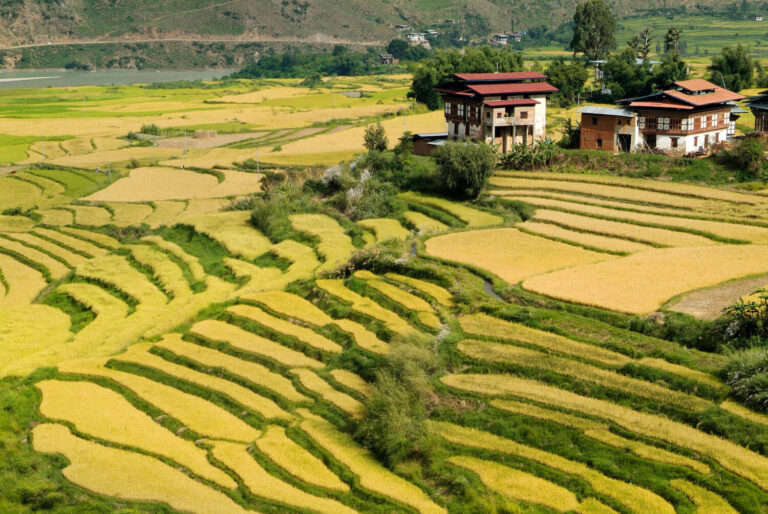
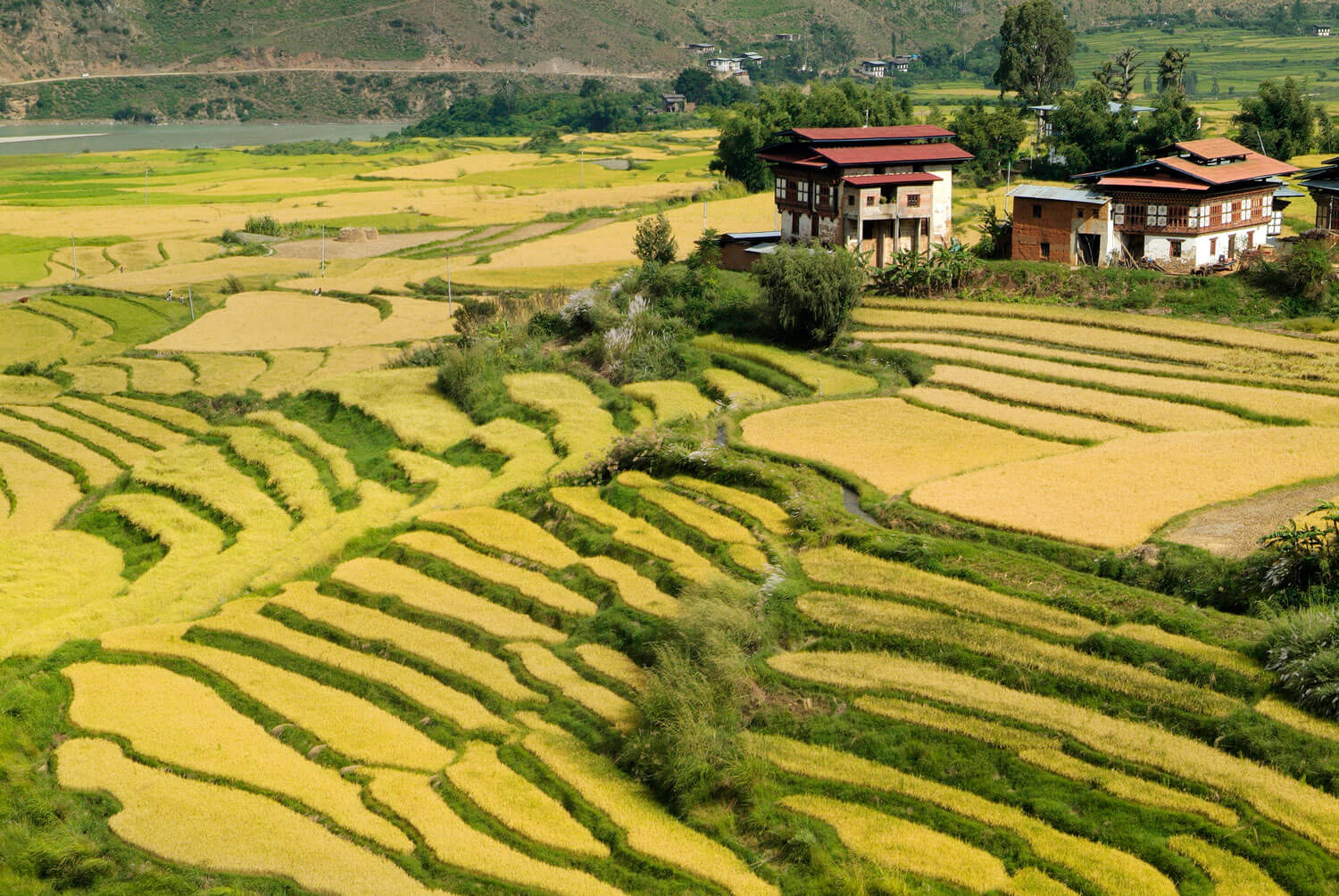
Day 14: Thimphu to Punakha. Three hours over Dochula at 10,170 feet (3,100 m), then down to about 4,300 feet (1,310 m). Chimi Lhakhang in the afternoon.
Day 15: Punakha. The dzong at the river confluence, unhurried. Afternoon: the climb to Khamsum Yulley Namgyal Chorten, or the Mo Chhu float. A hot stone bath in the evening.
Day 16: Punakha to Phobjikha. Four hours to the glacial valley at about 9,800 feet (3,000 m). Gangtey Goenpa and the nature trail. Black-necked cranes from late October.
Day 17: Phobjikha to Paro. A long drive west, five to six hours, with a farmhouse lunch. Afternoon in Paro.
Day 18: Paro. Kyichu Lhakhang, the Rinpung Dzong and the National Museum. Afternoon up to Chele La at 12,400 feet (3,780 m), which after three weeks in the Himalaya is the right way to end the mountain part of the trip.
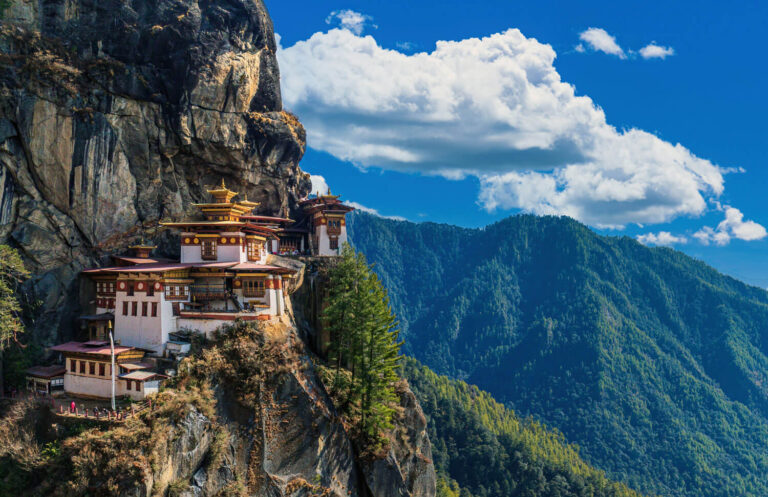
Day 19: Tiger’s Nest. Paro Taktsang at about 10,200 feet (3,120 m), roughly 1,700 feet (520 m) of steep ascent, two to three hours up. By this point you are as acclimatised as you are going to get.
Day 20: Paro, free. A spare day, held deliberately. If the Paro flight moves or the weather closes in, this absorbs it. If not, it is the Haa valley over the pass, or a day doing nothing.
Day 21: Departure. Transfer to Paro airport, out via Kathmandu, Delhi or Bangkok.
What is included
In Nepal: accommodation with breakfast, full board at the Chitwan lodge, private vehicle with an English-speaking driver, licensed local guides on the guided days, all monument and national park fees, the safari activities with naturalists, and the lake boats. In Bhutan: full board throughout, private vehicle with a Bhutanese driver, a licensed English-speaking Bhutanese guide throughout, all entry fees, the visa application, and the Sustainable Development Fee for all nine Bhutanese nights itemised per person per night. Throughout: the Kathmandu to Paro flight, all transfers, a single day-by-day document covering both countries, and a WhatsApp group with your specialists and our Delhi office.
What we would change, and when
- Want to trek? Swap Chitwan for the Ghorepani and Poon Hill loop out of Pokhara, three extra days, topping out at about 10,500 feet (3,200 m). Twenty-one becomes twenty-four.
- Want more Bhutan? Add Trongsa and Bumthang, which needs four more days. It also adds four more nights of the fee, and we will show you what that costs before you decide.
- Want less Bhutan? Cut Phobjikha and run a seven night Bhutan section. It saves two nights of fee and two nights of hotel, and it is the cheapest lever available on this route.
- Travelling June to September? We would advise different dates for both countries. Monsoon removes the mountains in Nepal and closes the passes in cloud in Bhutan.
Honest notes
The two countries are priced completely differently and it will look odd on the invoice. Eleven days in Nepal and nine days in Bhutan are not far apart in total cost. That is the fee doing its work, and we itemise it so the difference is visible rather than mysterious.
Bhutan cannot be travelled independently. A licensed guide and driver are with you throughout the Bhutan section. Nepal has no such requirement outside the trekking areas, and the change of feel between day 11 and day 12 is noticeable.
The Kathmandu to Paro flight is weather-dependent at both ends, and both airports have limitations. Day 20 exists partly as a buffer. We do not schedule a same-day international connection out of Paro.
Nepal is harder work than Bhutan. The roads are worse, the air in Kathmandu is poor in winter, and the contrast between the countries includes a contrast in comfort. People who come to Bhutan first sometimes find Nepal a shock. Doing it in this order is deliberate.
Tiger’s Nest is genuinely steep and it lands on day 19, which is the right place for it.
Rhino sightings at Chitwan are close to reliable in the right season. Tigers are not. Chitwan has tigers and most visitors do not see one.
Built by your named Bhutan specialist with our Nepal team, and checked by our Delhi office before it goes out.