The country works because four of the great cities of the Islamic world sit in a line across it and a modern railway connects them. It stops working in July, when the temperature in Bukhara goes past 100°F (38°C) and a tiled courtyard at noon becomes something to endure. This is the document our consultants open when a new Uzbekistan file lands on the desk, written out in full.
Uzbekistan at a glance
| Best months | April to May, and September to October |
| Comfortable trip length | 10 to 12 days |
| Entry | Visa-free for a long list of nationalities, electronic application for others |
| Getting around | The Afrosiyob high-speed train, plus a car and driver |
| Land budget, per person per day | 115 to 530 US dollars |
| Our presence | A long-standing Tashkent partner, not an office of our own |
Uzbekistan is about the size of California and doubly landlocked, which is a rare thing. It is also very flat in the middle: the drive from Bukhara to Khiva crosses about 280 miles (450 km) of Kyzylkum desert with almost nothing in it.
When to travel
There are two windows and they are narrow. Everything else is a compromise, and we will say which compromise you are making.
Spring, late March to May
The best season. Late March brings Navruz, the new year festival on the spring equinox, which is a genuine national celebration rather than a display for visitors. April is green, the steppe flowers, and the temperature in Samarkand sits in the seventies Fahrenheit (low twenties Celsius). Late April into mid May is the single best fortnight of the year.
By the end of May it is already hot in Bukhara and Khiva, into the nineties Fahrenheit (mid thirties Celsius), and the season is closing.
Summer, June to August
Do not, if you have any choice. Bukhara and Khiva routinely exceed 100°F (38°C) and can go considerably higher. Khiva’s walled city is unshaded brick and tile and holds the heat into the evening. Samarkand is a little better and not much.
If your dates are fixed to summer, and for many people they are, we build a different trip: out of the hotel at six, monuments until eleven, a long break, and back out at five. You will see the same places and less of them, and we would rather tell you that in advance. Hotel rates fall in July and August, which is the one consolation.
Autumn, September to October
The second window and the one with the best food, because it is the harvest: melons, grapes, pomegranates and figs. September starts hot and is comfortable by the middle. October is excellent and quieter than April. By the end of October the evenings are cold and the Nuratau yurt camps are closing.
Winter, November to March
Cold, clear and very cheap. The Registan with snow on it and nobody else in the square is a genuinely different experience, and we have clients who go back in January precisely for that. What you lose is the mountains, the yurt camps, and any outdoor eating. Some hotels in Khiva close.
How many days do you actually need?
- Under 8 days. Tashkent, Samarkand and Bukhara. Khiva does not fit, and trying to force it means a very long drive or a poor flight.
- 10 days. The four cities, properly, with a rest day. This is the shape most first visits should take. Our 10-day route is here.
- 12 days. The four cities plus one of: the Nuratau mountains and a yurt camp, the Fergana craft valley, or two extra nights in Bukhara doing nothing.
- 14 days. The four cities plus Fergana plus Shakhrisabz, or the four cities plus the long road north to Nukus and the Aral. The 14-day route.
- 21 days. Uzbekistan thoroughly plus Kyrgyzstan over the Fergana border, or Turkmenistan on a transit visa if it is granted. The 21-day route.
Entry requirements
Uzbekistan has opened up substantially. A long list of nationalities, including the United Kingdom, all EU states, Australia and Japan, now enters without a visa for a tourist stay. Others, including at times US passport holders, use an electronic application that is straightforward and processed quickly.
Because these rules have changed repeatedly in recent years and continue to, we do not publish the list here. We confirm the current requirement for your exact passport in writing before we send a quote. If you need an electronic visa, we tell you when to apply and what it costs.
One practical note that catches people: registration. Hotels register your stay for you automatically, and you should keep the small slips they give you until you leave the country.
Getting around
The train
The Afrosiyob high-speed service is the best thing about travelling in Uzbekistan and the reason a ten-day route is comfortable rather than exhausting. Tashkent to Samarkand takes a little over two hours. Samarkand to Bukhara takes about an hour and a half. The trains are clean, punctual and air-conditioned, and business class costs very little more than economy and is worth it.
They also sell out. Tickets are released a fixed number of weeks ahead and the popular departures in April, May, September and October go quickly. This is the single most common way an Uzbekistan itinerary goes wrong, and it is entirely avoidable. We book your seats the day the window opens, before anything else on the trip is confirmed.
Bukhara to Khiva is the exception. There is a slower overnight train, and there is a drive of about six hours across the Kyzylkum desert, which is flat, empty and more interesting than it sounds, with a stop at the Amu Darya. We usually drive it westbound and fly back from Urgench to Tashkent.
Flights
Domestic flights connect Tashkent with Urgench for Khiva and with Nukus for the Aral region. They save a long day and they are cheap. Schedules change with little notice, so we do not build a tight connection onto one.
Car and driver
For everything the train does not cover: the desert crossing, the Nuratau mountains, Shakhrisabz over the pass from Samarkand, and the Fergana valley over the Kamchik pass. Roads are generally good. Self-drive is possible and we do not recommend it.
What a trip to Uzbekistan costs
Figures are land only, per person, based on two sharing, and exclude international flights. They cover accommodation, food, ground transport, train tickets, entries and the guiding we would normally include.
| Style | Per day | 10 days | 12 days | 21 days |
|---|---|---|---|---|
| Careful: family-run guesthouses, light guiding | $115 | $1,150 | $1,380 | $2,415 |
| Comfortable: good 3 to 4 star, guided in each city | $185 | $1,850 | $2,220 | $3,885 |
| Boutique: restored caravanserai and merchant houses | $310 | $3,100 | $3,720 | $6,510 |
| Luxury: the best rooms in the country, guided throughout | $530 | $5,300 | $6,360 | $11,130 |
Uzbekistan is inexpensive by any international standard. Food is very cheap and very good. Site entries are modest. The two lines that move the total are the standard of hotel, where the gap between a pleasant guesthouse and a restored caravanserai is large, and the amount of private guiding, which we think is worth more here than in most countries because the buildings are unreadable without it.
The cities, and what to do with them
Tashkent. Most people give it half a day and should give it one and a half. It is a Soviet-planned city, rebuilt after the 1966 earthquake, and that is what makes it interesting: a metro with individually designed marble and mosaic stations, serious modernist architecture, the Chorsu bazaar under its blue dome, and at the Khast Imam complex the Uthman Quran, one of the oldest surviving Quran manuscripts in the world. Also the best restaurants in the country, by a distance.
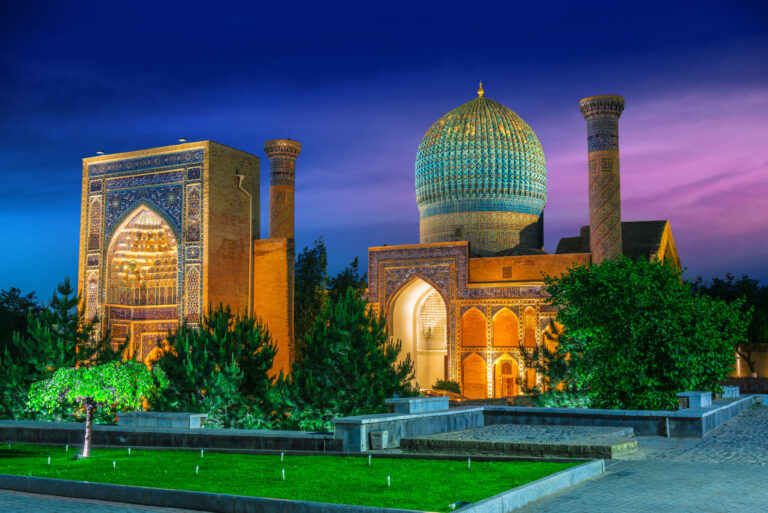
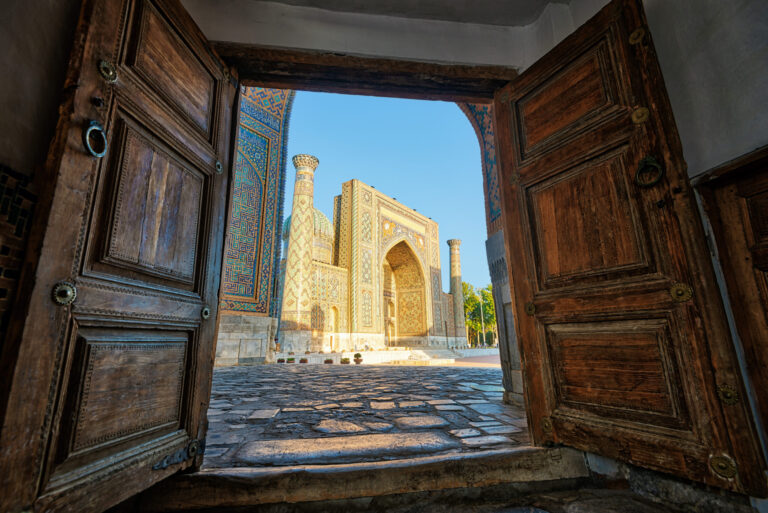
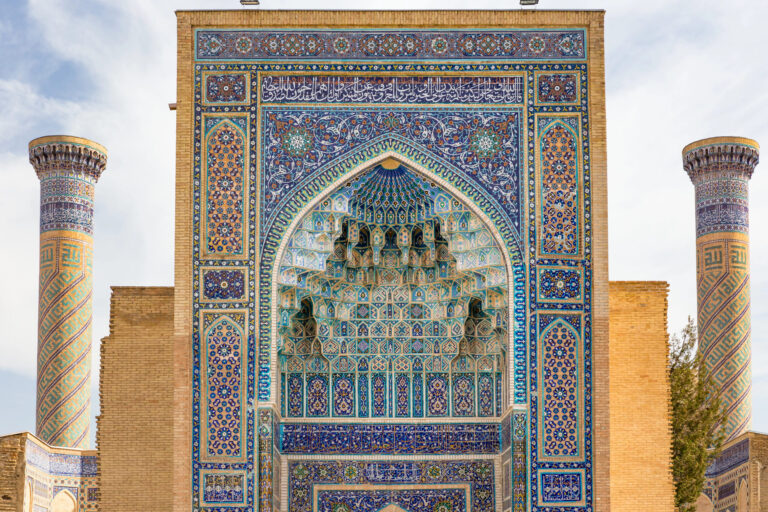
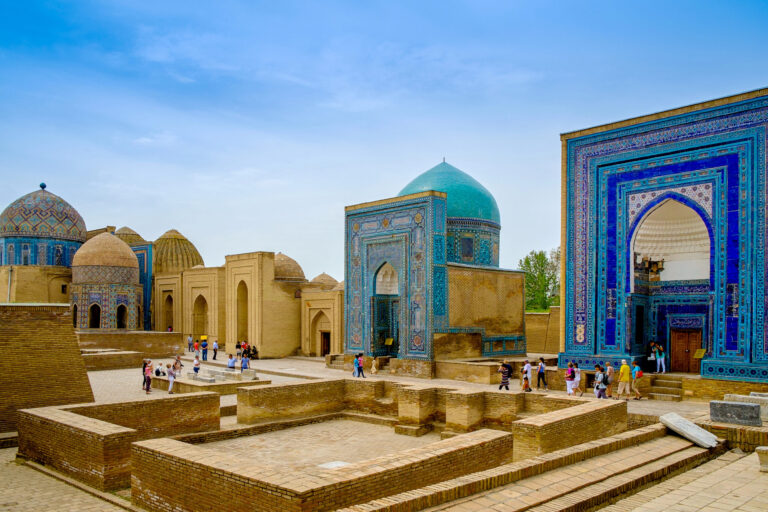
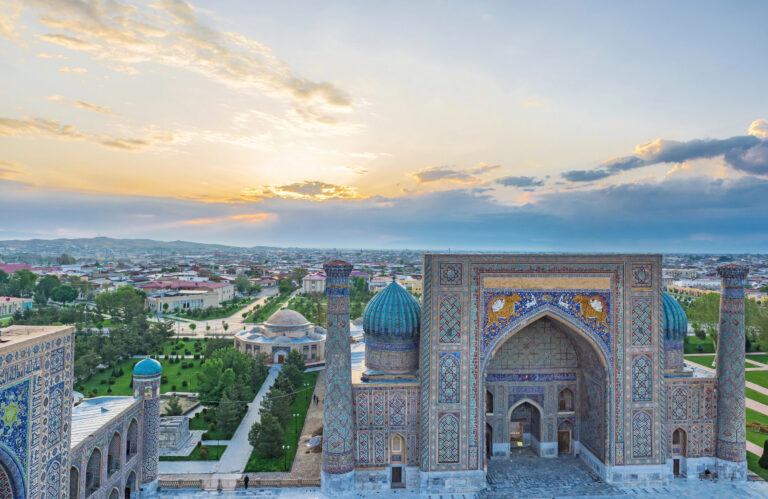
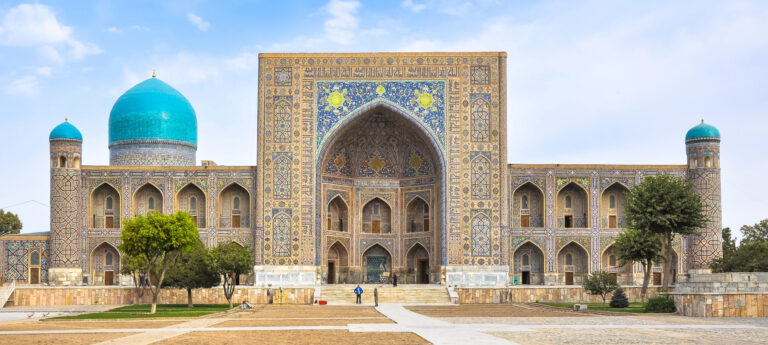
Samarkand. The Registan, three madrasas facing a square, is the image of Central Asia and it deserves to be. Gur-e-Amir, where Timur is buried. Bibi-Khanym, enormous and largely rebuilt. Shah-i-Zinda, a lane of tiled tombs that is the most beautiful thing in the city and best at eight in the morning. Ulugh Beg’s observatory, of which the underground arc of the sextant is original and the rest is not. Three nights.
Bukhara. Our own favourite, and the city where the old town still functions as a town. The Kalyan minaret of 1127, which Genghis Khan reportedly left standing. The Ark fortress. The Samanid mausoleum, tenth century, unrestored brickwork and the oldest significant building in the country. The trading domes, Lyabi-Hauz, and about a hundred and forty listed buildings inside a walkable area. Three nights, and you will still leave things.
Khiva. The walled city of Ichan Kala, which is compact, complete and extraordinary at dawn and dusk. It is also the most museum-like of the four: heavily restored from the 1970s, with a large share of the buildings converted to display space and comparatively few people living inside the walls. Two nights, one of them so that you can walk it after the day groups leave.
Shakhrisabz. Timur’s birthplace, over a pass from Samarkand. The Ak-Saray palace portal is a fragment of something that must have been astonishing. Be aware that the surrounding old town was cleared and rebuilt in 2015 and UNESCO placed the site on its list of World Heritage in Danger in 2016. It is a half day, and a complicated one.
The Fergana valley. Where the craft is. Rishtan for ceramics in the blue and turquoise ishkor glaze, Margilan for silk and ikat, Kokand for the khan’s palace. Over the Kamchik pass from Tashkent, and worth two to three days for anyone interested in how things are made.
Nurata and the Nuratau mountains. Village guesthouses in the hills, walking between them, and yurt camps by Lake Aydarkul on the edge of the Kyzylkum. Two nights, and the best break in a route that is otherwise all cities.
Nukus and the Aral. The Savitsky Museum in Nukus holds one of the world’s great collections of Soviet avant-garde painting, saved by being hidden 1,200 miles from Moscow. Beyond it, Muynak, where the ship graveyard sits on what was the seabed. It is a long, hot, uncomfortable journey and it is one of the most affecting places we send people.
Food
Better than its reputation, and heavily seasonal. Plov, rice cooked with lamb, carrot and cumin in a cast-iron kazan, is the national dish and differs by city: Tashkent plov is one thing, Bukhara and Samarkand versions are others, and it is eaten at lunch rather than dinner. Samsa baked on the wall of a tandoor. Lagman noodles, which are Uighur in origin. Shashlik. Non, the round stamped bread, which is different in every city and is genuinely worth paying attention to. In Khiva, shivit oshi, green dill noodles, which exists nowhere else.
Vegetarians manage but should expect repetition. Tell us early and we brief the restaurants, which works.
Practical notes
- Cash and cards. Cards are now widely accepted in the cities. Carry som for bazaars, taxis and workshops. Dollars are useful and should be clean and unmarked notes.
- Dress. Uzbekistan is a secular state and dress is relaxed. At working mosques, cover shoulders and knees, and women should carry a scarf.
- Alcohol is legal and available, and Uzbek wine and brandy are better than you expect.
- Heat. From May to September, the middle of the day is the enemy. Hat, water, and a hotel with a pool if the budget allows.
- Language. Uzbek in the Latin alphabet, with Russian widely used and Cyrillic still on many signs. English is limited outside hotels and guides.
- Photography. Fine almost everywhere. Ask before photographing people, particularly women, and do not photograph inside working mosques during prayer.
How we build an Uzbekistan trip
Your itinerary is written by a named person: our Head of Consulting Mai Est, or our Central Asia specialists Osnat Angerman and Paz Prosianoy. On the ground we work through a Tashkent partner we have used for years rather than an office of our own. We have dedicated local offices in Vietnam and India, our team in Japan, and local representatives in the Philippines, and we would rather tell you that than let you assume otherwise.
What it means in practice is that the guide who meets your train, the driver across the desert and the person who answers at two in the morning are theirs, briefed by us, with your consultant on the same WhatsApp thread from take-off to landing. Your $39 plan is written for you rather than pulled from a template, and if you want us to book the trip, the quote is free and carries no obligation.
Ready to plan it?
Tell us the shape of the trip you have in mind and we will build you a first outline. A plan written for you, and a free, no-obligation quote if you want us to book.
Keep reading
- The eight Uzbekistan itineraries we build most often
- Uzbekistan month by month
- The Afrosiyob train, explained
- Samarkand: what is original