So this article states the seasons plainly, including the two exceptions where the general rule is wrong, and it gives temperatures at both ends of a country that runs from 200 feet (60 m) in the Terai to 29,032 feet (8,849 m) at the summit of Everest.
The year at a glance
| Month | Kathmandu, average high | Mountain visibility | Trekking | Our verdict |
|---|---|---|---|---|
| January | 66F (19C) | Excellent, cold and sharp | Lower routes only | Clear, cold, quiet, smoggy mornings |
| February | 70F (21C) | Very good | Lower and mid routes | Improving through the month |
| March | 77F (25C) | Good, haze beginning | Yes, good | The start of the spring window |
| April | 84F (29C) | Moderate, hazy | Yes, the rhododendrons | Very good, warmer and hazier |
| May | 88F (31C) | Poor to moderate | Last workable pre-monsoon weeks | Hot low down, hazy high up |
| June | 86F (30C) | Poor | Not recommended | The monsoon arrives |
| July | 84F (29C) | Very poor | No | Avoid, except the rain shadow |
| August | 84F (29C) | Very poor | No | Avoid, except the rain shadow |
| September | 84F (29C) | Improving late in the month | From about the third week | The tail, and unreliable |
| October | 79F (26C) | The clearest of the year | Peak season | The best month, and the busiest |
| November | 73F (23C) | Excellent | Peak, colder at height | Equally good, colder at night |
| December | 66F (19C) | Excellent | Lower routes, cold nights | Clear, cold, empty, cheap |
Temperatures at trekking altitude are a different matter entirely and are covered below.
October and November, the best window
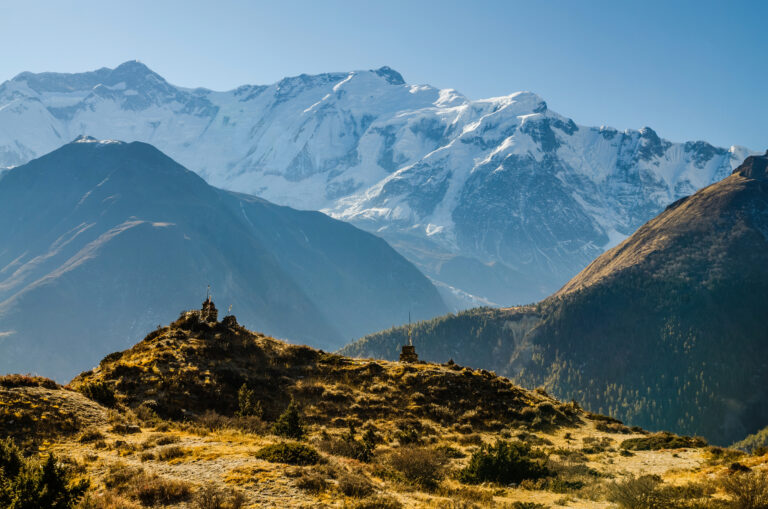
The monsoon has washed the dust out of the air, and what is left is the clearest visibility of the Nepali year. The Himalaya is visible from the valley rim on most mornings, temperatures at trekking altitudes are comfortable during the day, and the trails are dry.
This is peak season and it is peak for good reason. It is also busy in a way that shapes the trip:
- Lodges on popular routes fill by early afternoon, which means starting early and having a guide who books ahead.
- Lukla flights run at capacity and the backlog after a weather day is longer.
- Prices are at their annual high, which is reflected in what a trip to Nepal costs.
- Six to nine months of lead time is realistic for October and November.
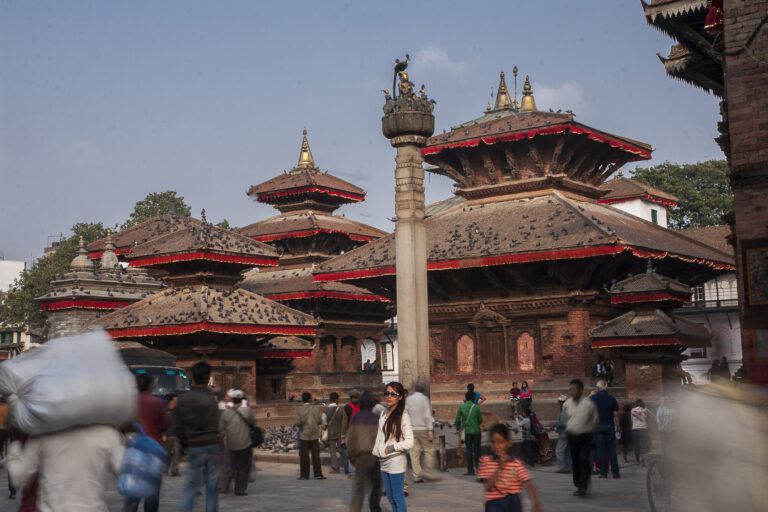
Dashain and Tihar, the two biggest Hindu festivals, fall in this window on lunar dates that move each year. They are extraordinary to be present for, and they close offices, empty Kathmandu of its workforce and fill domestic flights. We plan around them rather than through them and confirm the current year’s dates before quoting.
Night temperatures. In late October at 14,000 feet (4,270 m) expect nights around 20F (minus 7C) inside an unheated plywood room. By late November at the same height it is meaningfully colder. This is why our kit list is specific rather than general.
March and April, the second window
Warmer, greener, and with one advantage October does not have: the rhododendron forests of the Annapurna and Everest foothills flower from late March through April, and on the right week they are the best thing in the country. The Ghorepani ridge in the first half of April is a red forest.
The trade is haze. Dust and pre-monsoon humidity build steadily through the spring, so the mountain views are less reliably sharp than in autumn. You will still see the Himalaya. You will less often see it perfectly.
Trails are slightly quieter than October and the lodges are less pressed. For a first trek, if you cannot get October, this is the window we would take, and it is when we most often run the Annapurna teahouse trek.
May is hot in the lowlands, at 88F (31C) and up in the Terai, hazy in the hills, and the last workable pre-monsoon weeks at altitude. Chitwan in May is uncomfortable and the wildlife viewing is good because the grass has been cut and the animals come to water.
June to September, the monsoon
We will say this plainly because it is the most common expensive mistake in Nepal planning: the monsoon genuinely removes the mountains.
From roughly mid-June to mid-September the Himalaya sits behind cloud for days at a time. Trails are wet and slippery, leeches are on the lower forest paths, flights to mountain airstrips cancel repeatedly, landslides close roads, and the scenic mountain flight from Kathmandu is often grounded for a week.
We tell people with fixed July dates to go somewhere else, and we mean it. A comparison of how the monsoon behaves across the region is in the monsoon in Asia.
Two real exceptions, and they matter.
Upper Mustang and Dolpo sit in the rain shadow behind the main Himalayan range and are at their best in summer, when the rest of the country is unwalkable. Both are restricted areas needing a separate and expensive permit and a minimum group size, and both are serious undertakings rather than casual additions. If your only possible dates are July and August and you want to trek, this is the honest answer, and it is a good one.
The Kathmandu valley in the monsoon is green, cheap, uncrowded and atmospheric, and the Newari cities in the rain are memorable. If the mountains are not the point of your trip, a monsoon valley trip is perfectly defensible and costs a fraction of the October equivalent. We would just rather you chose it deliberately.
December to February, cold and clear
Underrated, with conditions attached.
The high peaks are sharp, the trails are quiet, the lodges are empty and prices are at their lowest. What you pay for it is cold: nights well below freezing at trekking altitude, and enough snow on the high passes to close them.
The Kathmandu valley in winter has a specific problem worth naming, which is air quality. Cold air traps the valley’s pollution in the mornings from roughly December to February, and the Himalayan view from Nagarkot that is a certainty in October is often a grey wall until the sun burns it off.
Trekking is workable at lower and mid altitudes with proper kit. The Everest and Annapurna base camp routes are done in winter by well-equipped groups, with genuinely cold nights at the top end. We do not run the Annapurna Circuit’s Thorong La in deep winter, and we will say no rather than take the booking.
Region by region
| Region | Best months | Worth knowing |
|---|---|---|
| Kathmandu valley | Oct, Nov, Mar, Apr | Winter mornings are smoggy. Monsoon is green and cheap |
| Everest region, Khumbu | Oct, Nov, then Mar, Apr | Lukla flights cancel in every season. Nights are brutal in Nov |
| Annapurna region | Oct, Nov, Mar, Apr | Road-accessible trailheads, so no flight risk. Rhododendrons in April |
| Pokhara | Oct to Apr | Mountain views from Sarangkot need a clear dawn, which autumn gives most reliably |
| Chitwan and the Terai | Oct to Mar | Hot from April. Grass is tall until it is cut in the new year, which affects sightings |
| Upper Mustang and Dolpo | Jun to Sep | The rain shadow exception. Restricted permits, minimum group sizes |
So which month would we book?
The second half of October if you want the clearest air of the year and can book six months ahead.
The first half of November if you would rather have slightly emptier trails and can handle colder nights, which is often our own preference.
Early April if autumn is impossible, for the rhododendrons, accepting the haze.
Late January for a valley and Chitwan trip at low cost with sharp mountain views and cold mornings.
The month we would refuse to build a mountain trip in is July, and the honest alternative in July is either Upper Mustang or another country entirely. That is the sort of answer set out in what we would skip in Nepal.
Plan this trip
Tell us your dates and the places you want to see, and we build your trip as a $39 day-by-day plan, with recommended hotels by level and every transfer set out step by step.
Keep reading
- Nepal: the complete guide to planning your trip
- What a trip to Nepal costs, trek included
- Everest or Annapurna: which trek suits which walker
- The Annapurna teahouse trek, 15 days
- Classic Nepal in 12 days
- All our Nepal trips