That condition is not caution for its own sake. A child cannot reliably describe altitude symptoms, cannot always distinguish a headache from being tired and cold and hungry, and the margin for error at 14,000 feet is small. So we build family trips in the valley, the hills, Pokhara and the lowlands, where the country is warm, gentle and full of things children like, and we say no to the rest.
This is the reasoning behind Nepal with children in 12 days.
Why the low route works so well
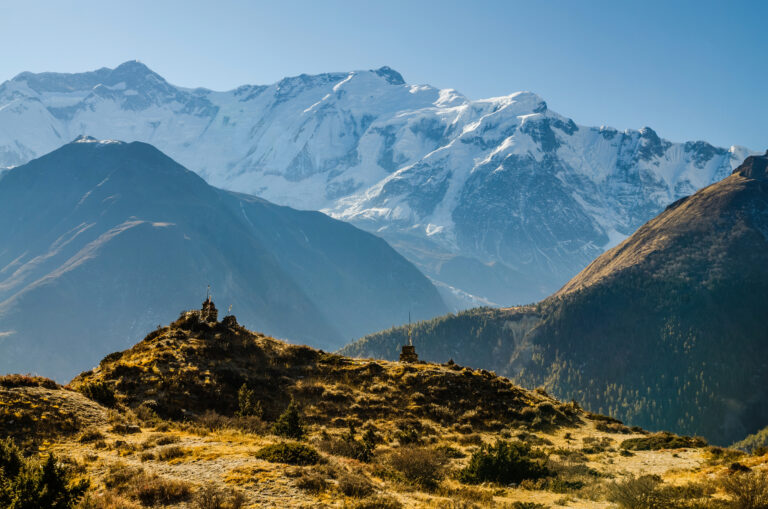
The Himalaya is visible without walking into it. From Nagarkot on the valley rim at about 7,100 feet (2,175 m), or from Sarangkot above Pokhara at about 5,250 feet (1,600 m), a clear dawn shows you the whole range. Children who would revolt at nine days of stone staircases will get up at half past five for that.
There are rhinos. Chitwan has the highest concentration of greater one-horned rhinoceros in Asia and they are genuinely common, not a lucky sighting. For most children this is the trip.
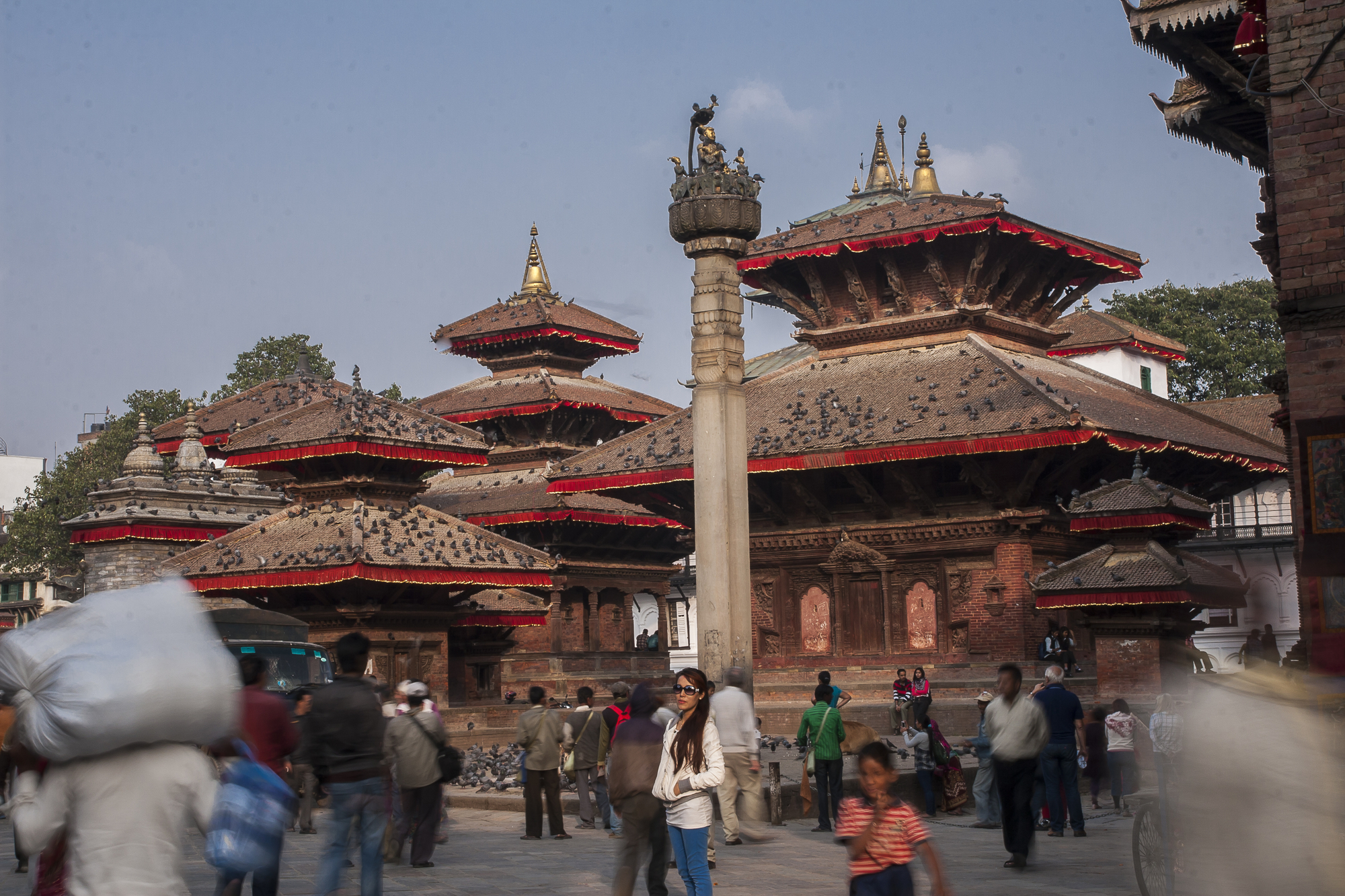
The cities are compact and full of animals, workshops and things being made. Bhaktapur’s Potters’ Square has potters in it. The metal casting workshops behind Patan Durbar Square are working foundries. Nepali cities are not museums and children notice the difference.
Nepali people are unusually good with children. Restaurants, lodges and guides all treat a child as a guest rather than an inconvenience, and yours will be talked to, fed and fussed over constantly.
The route we build
Twelve days, three main bases, no night above 7,100 feet (2,175 m).
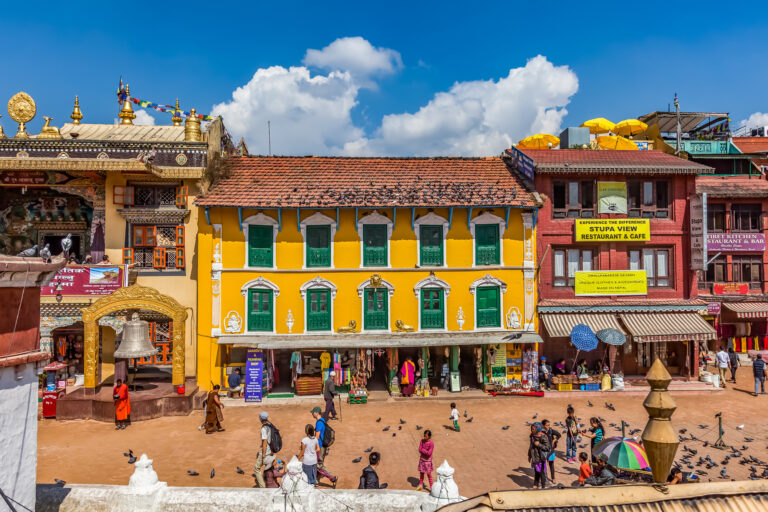
Days 1 to 4, the Kathmandu valley. Patan and Bhaktapur rather than central Kathmandu for the walking, because both are calmer and the old centres are largely traffic-free. Boudhanath at dusk, when the circumambulation fills and there is a great deal to look at. A morning at the metal workshops or a paper-making or thangka-painting workshop, which is the kind of thing children remember. A night at Nagarkot on the rim for the sunrise.
We would skip Pashupatinath with younger children. It is one of the most significant sites in the Hindu world and it is an active open-air cremation ground. With older teenagers, and with a guide who explains it properly, it is extraordinary. With a nine-year-old it is a difficult afternoon.
Day 5, Bandipur. The drive west broken by a night in a Newari ridge town with a car-free main street, which means children can be let off the lead for the first time in the trip. This is the night families mention afterwards.
Days 6 to 8, Pokhara. A lake, rowing boats, bicycles, paragliding for teenagers off Sarangkot, the Mountain Museum for a wet afternoon, and a two-hour walk up to Australian Camp for a closer mountain view, which is about the right amount of walking for most children. Build in a day with nothing in it.
Days 9 to 11, Chitwan. The canoe on the Rapti at dawn, past crocodiles on the banks. A jeep safari. A Tharu village visit. And the elephant breeding centre, which is worth understanding correctly: we do not use elephant-back safaris anywhere, and we will explain to your children why, because they will ask.
Day 12, back to Kathmandu. Fly if the drive would end the trip badly.
What works, in detail
- The dawn things. Sunrise from Nagarkot and Sarangkot are the two best mornings in Nepal and children handle early starts better than parents expect when there is a reason.
- The walking safari at Chitwan with two trained naturalists, for children old enough to be quiet and to follow instructions, which realistically means about ten and up. It is how you see rhino properly and it is done on foot for a reason. Younger children go in the jeep.
- The workshops. Paper, pottery, thangka painting, metal casting. An hour of doing beats three hours of looking.
- Momo. Dumplings, universally liked, available everywhere, and children can be shown how to fold them.
- Boats. Phewa Lake in Pokhara, and the canoe at Chitwan.
- A short walk with a real destination. Australian Camp above Pokhara, or the World Peace Pagoda across the lake, which is a boat and a 45-minute climb.
What does not work
Altitude, and we mean it. We do not take young children on high-altitude routes. The reason is stated plainly in Nepal for the first time and it applies with more force to children: acute mountain sickness is not related to fitness or age, its early symptoms are headache, nausea, loss of appetite, dizziness, unusual fatigue and broken sleep, and a child may not report any of them clearly. Do not climb higher with symptoms, and if they do not clear, descend 1,500 to 3,000 feet (450 to 900 m), which usually resolves it. Our guides descend rather than argue, and with a child in the party that decision comes sooner rather than later.
For older teenagers who walk regularly at home, a foothill trek topping out around 10,500 feet (3,200 m), like the Ghorepani and Poon Hill loop, is a different conversation and one we are happy to have.
Long road days. Kathmandu to Pokhara is six to eight hours on winding roads. With children we fly one leg, and we break the other at Bandipur. Nobody enjoys the full drive twice.
Central Kathmandu on foot for hours. Traffic, dust, no pavements in places, and poor air quality in winter. We stay in Patan, walk Bhaktapur, and treat central Kathmandu as a half day with a car.
Teahouse trekking with young children. Plywood rooms, no heating, shared bathrooms that freeze, and a cold night at height. Adults find this atmospheric. Children find it cold.
Too many temples in a row. Three durbar squares in three days is one too many for anyone under fifteen. We break them up with workshops, the lake and the jungle.
Health and practicalities
Food. Nepal is one of the easiest countries in Asia for feeding children. Dal bhat is mild, endlessly refilled and vegetarian by default. Momo, fried rice, noodle soup, potatoes, eggs and Tibetan bread are all safe ground, and the spicing is moderate compared with India. More detail is in what to eat in Nepal.
Water. Purified only, including for brushing teeth. We provide purification and lodges sell boiled or filtered water.
Stomach trouble. The rule that works is to eat what is being cooked constantly rather than what has been sitting, which means dal bhat and busy restaurants.
Vaccinations and medical advice are a conversation with your own doctor or a travel clinic, well before departure, not with us.
Medical facilities. Good private clinics in Kathmandu and Pokhara, considerably less in between, which is another reason our family routes stay on the main road corridor.
Rooms. Family rooms and triples exist in the hotels we use in the valley and Pokhara, and jungle lodges at Chitwan are generally good for families with connecting or family units. We confirm the bedding arrangement in writing rather than assuming.
Ages, roughly
Under five. Workable, and the trip becomes the lake, the animals and the courtyards rather than the sites. Roads are the limiting factor, so fly the long legs.
Five to nine. Good. Chitwan is the highlight, the workshops land well, and the walking should stay under two hours a day.
Ten to thirteen. The best window. Old enough for the walking safari, the dawn starts, a two or three hour hill walk and the history. This is where our twelve-day family route is pitched.
Fourteen and up. Now a foothill trek becomes possible, paragliding at Pokhara is on the table, and Pashupatinath with a good guide becomes one of the most memorable hours of their lives. An Everest or Annapurna Base Camp route is still a serious undertaking that we would discuss on its own terms, with the full altitude conversation, and never as a family add-on.
For how Nepal compares with the other countries we build family trips in, see Asia with children.
When to go with children
October and November for the clearest air and the most reliable mountain views, or March and April, which are warmer and hazier and green. Avoid the monsoon from mid-June to mid-September, when the mountains are behind cloud, the roads have landslides on them and the trails have leeches. Chitwan is hot from April onward, which matters more with young children than with adults. The full picture is in Nepal month by month.
Plan this trip
Tell us your dates and the places you want to see, and we build your trip as a $39 day-by-day plan, with recommended hotels by level and every transfer set out step by step.
Keep reading
- Nepal with children, 12 days
- Classic Nepal in 12 days
- Nepal for the first time
- Asia with children, country by country
- Nepal: the complete guide