The Sustainable Development Fee is charged per person for every night you spend in the country. That means an unnecessary valley is not just a dull afternoon, it is a fee, a hotel, a drive and a day you could have spent somewhere better. The discipline that pays off here is subtraction.
So here is the honest list. Some of these are things we would drop entirely. Some are things we would keep but shorten. All of them appear on itineraries we are asked to review.
1. A second full day in Thimphu
Thimphu is the capital and the only city, and it is not a beautiful one. It is a valley of concrete and traditional detailing that has grown fast, and we do not pretend otherwise.
One day covers it well: the Buddha Dordenma above the valley, the National Textile Museum, which explains what people are wearing better than any guidebook, the arts school if you are interested in how the crafts are taught, twenty minutes at the takin preserve, and Tashichho Dzong late in the afternoon when the office day ends. If your dates catch the weekend, the Centenary Farmers Market replaces half of that and improves it.
A second day is usually filled with a paper mill, a postage stamp museum and a folk heritage house. None of those is bad. All of them are a night’s fee.
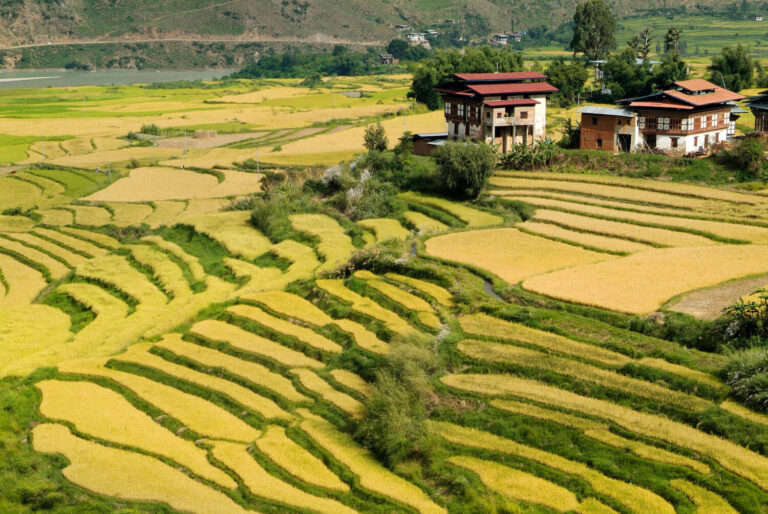
Skip it, and add the night to Punakha instead.
2. Thimphu on your arrival day
The standard build lands you at Paro at about 7,300 feet (2,225 m), drives you an hour to Thimphu at about 7,660 feet (2,335 m), and gives you the afternoon.
You have gained altitude and crossed time zones on the same morning. The afternoon is wasted whatever is in it, and on a family trip it is worse than wasted.
Skip the drive. Sleep in Paro, which is fifteen minutes from the airport, and go to Thimphu the next morning with a working head.
3. One-night stops anywhere
This is the biggest structural problem with most Bhutan itineraries. Six valleys in eight days looks generous on paper and it means you are packing every morning and arriving every evening.
The fee makes this worse. If your route has six one-night stops, you are paying six nights of fees to spend six half-days in cars.
Our rule: two nights everywhere on a first trip, with the exception of Trongsa, which is a genuine staging post with a very good afternoon in it. Our two-week route is built on this principle.
4. Bumthang on an eight day trip
Bumthang is the best part of Bhutan for a lot of people, and it is two days in a car each way from Paro. About 165 miles (265 km), four passes.
On an eight day trip, reaching it by road means four of your eight days are driving. Reaching it by air means two domestic flights on weather-dependent schedules with a trip that collapses if either moves.
Skip it under fourteen days, or fly one leg and accept that you are gambling a day. The valleys are described here so you can decide whether they are worth planning a longer trip around, which for many people they are.
5. The far east, on any first trip
Mongar, Trashigang, and the Merak and Sakteng valleys. Long drives on the country’s roughest roads, simple hotels, and almost no other visitors.
It is genuinely interesting and it is a third trip. On a first one it consumes a week and gives you a version of what you already saw in the west, more remotely and less comfortably.
Skip it, unless you have three weeks in Bhutan alone and have been before.
6. The idea that you need a big trek to have walked in Bhutan
Bhutan’s treks are camping treks with a full crew, and the accessible one, the Druk Path, is five walking days with four consecutive nights above 11,500 feet (3,500 m). It is a real commitment, it is cold, and it is not the only way to walk here.
If what you want is walking rather than trekking, skip the trek and build in the day walks: the Gangtey Nature Trail in Phobjikha, the climb to Khamsum Yulley Namgyal Chorten above Punakha, the temple-to-temple walk along the river in Bumthang, and the drive to Chele La at 12,400 feet (3,780 m) with a ridge walk from the pass.
Skip the trek if you were only doing it for the walking. Keep it if you want the altitude and the ridge.
7. Tiger’s Nest early in the itinerary
Not the climb itself, which is the best day on most Bhutan trips. The scheduling.
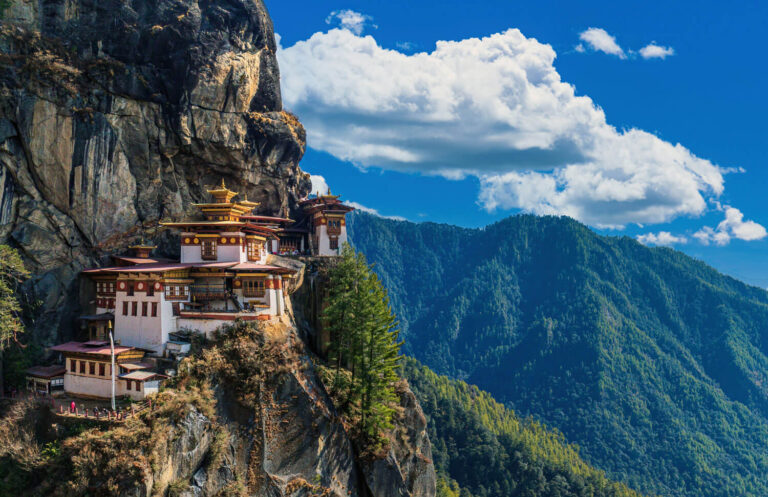
Roughly 1,700 feet (520 m) of ascent to about 10,200 feet (3,120 m), on legs that landed the day before yesterday, is a materially worse experience than the same climb on day seven.
Skip the early slot. If an itinerary you are shown has Tiger’s Nest on day two or three, ask why. There is occasionally a good reason, usually there is not.
8. The pony to Tiger’s Nest, if you think it solves the problem
Ponies carry you as far as the cafeteria at the halfway point and no further, and they do not take you down at all because the descent is too steep for a rider.
So a pony buys you the easier half of the ascent and leaves you the stairs, the upper path and the entire descent on foot.
Skip it unless you understand exactly what you are buying. If the climb worries you, the better plan is to walk to the cafeteria, enjoy the view that is in most of the photographs, and go back down.
9. Chasing a festival without holding the rooms first
Tshechu dates follow the Bhutanese lunar calendar and are confirmed relatively late. A festival that fell in early April one year can fall in late March the next.
Meanwhile, the hotels in that valley sell out before the dates are official, because operators hold space speculatively.
Skip the plan where you wait for confirmed dates and then book. It does not work. Either commit early against the expected window and let us adjust, or build a trip that is good regardless and treat the festival as a bonus if it lands.
10. Trying to make Bhutan cheap
We include this because it is the most common wasted effort we see.
The fee sets a floor under the entire country, and below that floor there is nothing. Shaving the hotel budget in Bhutan moves the total far less than it would in Vietnam, because the fee is fixed regardless of where you sleep. The result of a determined economy drive is usually a trip with simple hotels that still costs a great deal.
Skip the economising, and shorten the trip instead. Eight excellent days beats twelve compromised ones, and the money saved is real rather than marginal. If the budget is the binding constraint, the better answer is Bhutan paired with Nepal, where the days outside Bhutan cost a fraction of the days inside it. The cost article has the arithmetic.
What we would never skip
For balance, the things we would defend against any itinerary cut:
- Two nights in Punakha. The best valley on the standard circuit.
- A farmhouse lunch. Consistently the day people remember.
- Trongsa’s royal heritage museum, if your route goes east. The best museum in the country.
- Tiger’s Nest, late in the trip, with the option to stop halfway.
- An empty afternoon. Bhutan rewards the day with nothing in it more than most countries do.
Plan this trip
Tell us your dates and the places you want to see, and we build your trip as a $39 day-by-day plan, with recommended hotels by level and every transfer set out step by step.
Keep reading
- Bhutan: the complete guide to planning your trip
- The best two-week route through Bhutan
- How many days do you need in Bhutan?
- What does a trip to Bhutan really cost?
- Classic Bhutan in 8 days
- All our Bhutan trips